
Attack surface management for enterprise AppSec
Application attack surface management connects continuous discovery with security testing, risk prioritization, remediation, and posture measurement across enterprise applications and APIs.
Vulnerability exploitation is now the most common initial access vector in Verizon’s breach dataset. The 2026 Verizon Data Breach Investigations Report puts exploitation at 31% of breaches, compared with 13% for credential abuse.
At the same time, boards want better evidence that cyber risk is being managed. The National Association of Corporate Directors found that 43% of public-company directors and 57% of private-company directors consider improvements in management’s cyber-risk reporting “very” or “extremely important” for the coming year. NACD’s guidance calls for business-aligned, quantitative reporting rather than technical updates alone.
For AppSec leaders, that creates a practical question: Can you show which applications and APIs make up your attack surface, how much of that surface receives meaningful security testing, which risks deserve immediate attention, and whether security posture is improving?
Application attack surface management provides the operating model for answering those questions.
Application attack surface management essentials
- Application attack surface management is an AppSec discipline for continuously discovering, inventorying, testing, prioritizing, and governing application-layer risk across an enterprise portfolio.
- It differs from external attack surface management (EASM). EASM focuses primarily on externally visible assets and infrastructure. Application ASM goes deeper into web applications, APIs, application behavior, software components, and the security findings associated with them.
- Enterprise application attack surfaces are expanding across four overlapping dimensions: traditional web applications and APIs, microservices, AI-generated and AI-scaffolded software, and AI agent integrations.
- Effective attack surface management is backed by discovery to establish what exists, testing to find likely security weaknesses, and validation to identify reachable and exploitable vulnerabilities where technically possible.
- Board reporting on security posture across the attack surface should focus on coverage confidence, meaningful exposure, and posture trajectory rather than scan and finding counts alone.
- Application security posture management (ASPM) provides the operational layer for bringing findings, ownership, prioritization, remediation workflows, policies, and posture metrics together. In Invicti, ASPM is a core platform capability that connects these functions with DAST-first runtime intelligence and wider AppSec testing.
What is application attack surface management?
Application attack surface management is the continuous practice of discovering application assets, adding ownership and business context, testing those assets with appropriate AppSec methods, prioritizing risk, driving remediation, and measuring security posture across the software portfolio.
The relevant attack surface extends well beyond public websites. It includes authenticated functionality, APIs, microservices, application components, containers, cloud application infrastructure, and the software interfaces that connect applications to other systems.
The term “attack surface management” when applied to applications can create confusion because it is widely associated with EASM. The two disciplines have some overlap, but they answer different questions:
Both views are valuable. EASM can find an internet-facing asset that never entered an AppSec inventory. Application ASM can then establish how that application works, whether it receives appropriate testing, what security issues exist, and who owns remediation.
Four dimensions that are expanding the enterprise application attack surface
The enterprise application attack surface is growing in several directions at once. Treating all of that growth as generic “application sprawl” hides important differences in how assets are discovered and tested.
Traditional web applications and APIs
Conventional web applications and documented APIs remain the baseline. They typically have known owners, repositories, CI/CD workflows, specifications, gateway entries, or other integration points that make security coverage possible to automate.
They are also far from static. Applications gain new routes, API versions change, cloud configurations are modified, and features move between services. An application inventory that was accurate six months ago says little about the current reachable surface unless the underlying discovery and testing processes are continuous.
Microservices and service-to-service APIs
Microservice architectures multiply interfaces. A user might see one application, while AppSec has to account for dozens of services and the APIs connecting them. Some APIs appear in central gateways. Others exist only between internal services, are exposed directly from workloads, or become visible only through traffic.
That makes single-source API inventories unreliable. Gateway data is useful, but gateway visibility alone cannot account for APIs defined in source code, accessed through alternative routes, or deployed outside the managed gateway path. Multi-layer API discovery is therefore an important complement to static inventories.
AI-generated and AI-scaffolded software
AI-assisted development has changed the rate at which software can be created and modified, putting additional pressure on security processes.
AI-generated code can contain the same injection, authorization, authentication, configuration, and dependency risks as human-written software, but AI-assisted development can also amplify particular implementation patterns. In Invicti’s security analysis of 20,000 vibe-coded applications, one of the most striking findings was the prevalence of hard-coded and highly predictable secrets in source code. The research illustrates why rapidly generated software still needs established application security controls rather than being treated as a separate security problem.
The main operational problem is development velocity. More code, endpoints, integrations, and prototypes can reach development and deployment environments in less time. Discovery and testing processes now need to operate at software-delivery speed with significant automation rather than depend on occasional manual inventory work.
AI agent integration surfaces
Agentic applications add another layer of connections and authorization relationships.
Gartner predicts that 40% of enterprise applications will include integrated task-specific AI agents by the end of 2026, up from less than 5% in 2025. Gartner has subsequently warned that agent governance failures often arise when organizations fail to distinguish what an agent can do from the scope of access it has been granted.
The AppSec perspective is that each agent can interact with applications, APIs, tools, data stores, and other agents across different trust boundaries. Those underlying interfaces still require conventional application and API security testing. Agent-specific risks such as excessive permissions or unsafe tool use add to that requirement rather than replacing it.
Agents also present a separate inventory problem. Security teams need visibility into both the agent estate and the agent-facing applications and APIs involved. Invicti’s current guidance on agentic AI security and governance treats technical discovery as a necessary complement to governance inventories.
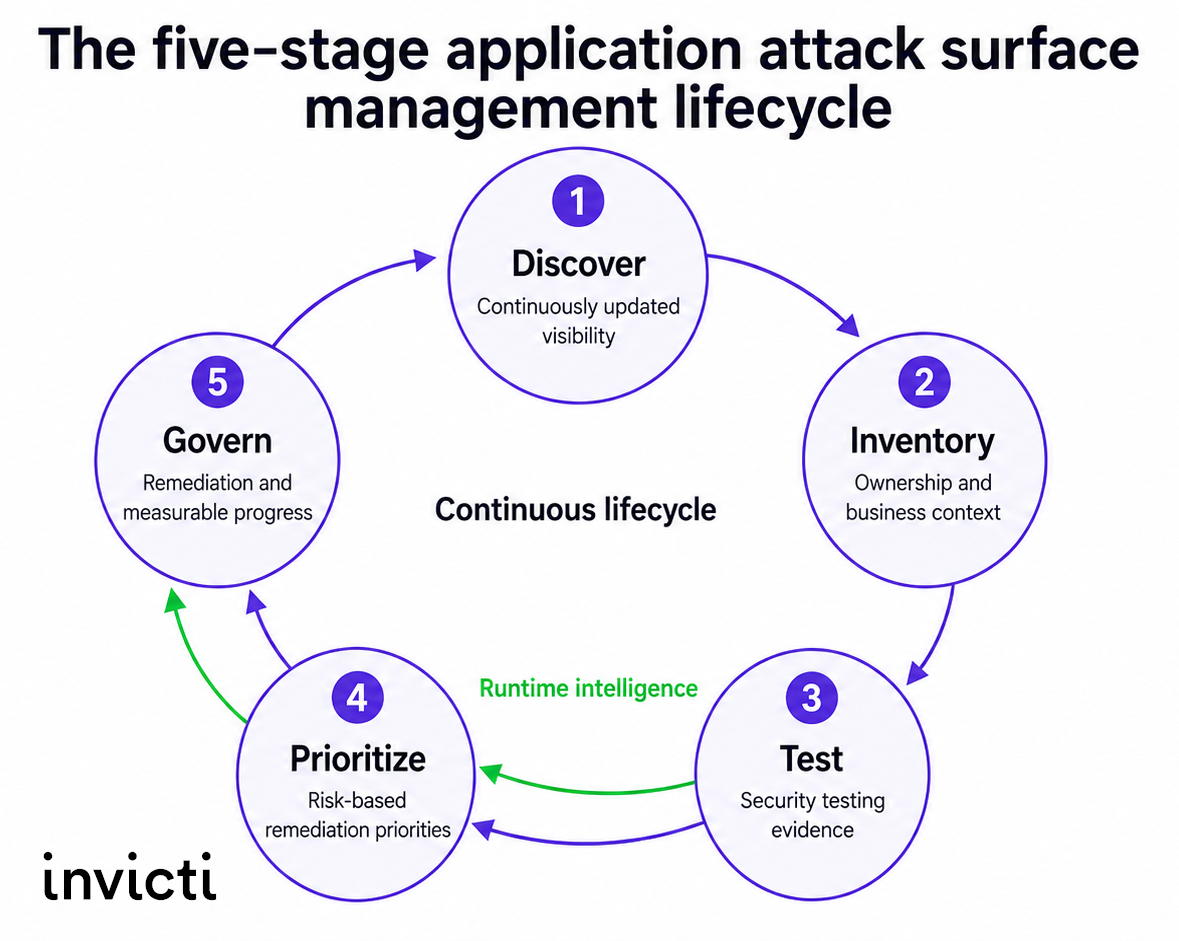
The five-stage application attack surface management lifecycle
Enterprise application ASM works best as a recurring operational loop:
Stage 1: Discover the application and API estate
You cannot test what you do not know exists. Applications and APIs exist across multiple environments and layers, so discovery needs to draw on multiple sources. For web applications, those can include existing inventories, CI/CD and deployment systems, DNS and web discovery, application crawling, and other operational data.
APIs require additional coverage because most expose no user interface and may not appear in a conventional application crawl. Invicti’s current API discovery model demonstrates why multiple discovery layers matter:
- Source-code discovery identifies API endpoints and specifications in repositories and can surface interfaces before deployment.
- Web application scanning observes API calls made by an application and extracts endpoints encountered during crawling.
- API gateway integrations retrieve APIs, schemas, and documentation from managed gateway platforms.
- Network traffic analysis identifies active APIs, including interfaces that may be undocumented or missing from central inventories.
Correlating these sources helps build a continuously maintained API inventory rather than treating any one source as authoritative.
Discovery should feed security testing directly. Finding another undocumented endpoint has limited value if it simply becomes another row in an inventory that nobody acts on.
For attack surface management, the most useful question discovery can answer isn’t “How many apps and APIs do we know about?” but “How many known apps and APIs have owners, appropriate security testing, and current risk information?”
Stage 2: Add ownership and business context
A hostname or endpoint is not enough information to manage application risk. An inventory needs enough context to determine what kind of testing is appropriate, who receives findings, how issues should be prioritized, and which assets require heightened scrutiny.
At a minimum, an enterprise application inventory should capture:
- Asset or application identity and relevant URLs or endpoints
- Owning development or product team
- Production, test, staging, or other environment
- Internet exposure
- Business criticality
- Data sensitivity and relevant regulated data
- Compliance scope where applicable
- Source repository or service relationship where available
- Security-testing methods applied
- Last meaningful test date and authentication coverage
- Open risk and remediation status
Ownership is especially important. Large organizations reorganize teams, acquire products, split services, deprecate applications, and move responsibilities. Static spreadsheets decay quickly or get lost across changes.
ASPM helps at this stage by connecting assets and findings to organizational and business context. Rather than creating another asset database for its own sake, the aim is to make the inventory operational: this application matters to this business process, belongs to this team, receives these tests, and currently has these security issues.
Invicti’s ASPM capability organizes findings across applications and projects, supports hierarchical views, centralized risk management, workflow integration, and remediation tracking within the wider platform.
Stage 3: Test what attackers can actually interact with
Discovery answers what exists, but it takes testing to establish what security weaknesses are present.
Different test types cover different parts of the problem:
- Static application security testing (SAST) examines source code.
- Software composition analysis (SCA) identifies risk in open-source and third-party components.
- Infrastructure-as-code (IaC) scanning looks for risky configuration before deployment.
- Container security examines deployable images and environments.
- Dynamic application security testing (DAST) exercises running applications and APIs.
DAST is particularly useful to application ASM because the practical attack surface ultimately exists in running software. Runtime testing can evaluate what an application actually exposes under its deployed configuration and behavior.
Authenticated testing is critical for applications and APIs where significant functionality sits behind login and authorization controls. For APIs, authorization weaknesses such as broken object-level authorization (BOLA) and broken function-level authorization (BFLA) require testing in multiple authenticated contexts.
For BOLA, the test needs to establish whether one authenticated user can improperly access another user’s objects. BFLA testing compares access across different roles or privilege levels. Invicti’s guide to authenticated API testing explains the multi-session process in detail.
Runtime testing can also provide evidence of exploitability. For supported DAST findings, Invicti’s proof-based scanning can safely confirm vulnerabilities by demonstrating that they are exploitable in the running application. This gives security and development teams stronger evidence for prioritization and remediation.
Runtime validation is one source of evidence, not a requirement for every AppSec finding. Some vulnerability types cannot be safely or automatically exploited, while findings from SAST, SCA, and other testing methods may identify risks that do not lend themselves to dynamic confirmation. These findings still need to be assessed on their own evidence and context. Where runtime validation is available, it adds confidence and helps teams distinguish demonstrated application risk from findings that require other forms of assessment.
Stage 4: Prioritize with runtime and business context
Enterprise AppSec teams have finite remediation capacity – and prioritization is what determines where that capacity produces the greatest reduction in risk.
CVSS severity can be one input, but it cannot describe the organization-specific consequences of a vulnerability. Useful prioritization also considers runtime evidence, reachability, internet exposure, business criticality, data sensitivity, known exploitation, threat intelligence, and other organizational context.
Consider two technically similar findings, both assigned a high technical severity. One affects an externally accessible payment workflow and has runtime evidence demonstrating exploitability. The other appears in an internal application with limited exposure and no corresponding runtime evidence. Both of them require remediation, but the operational priority to fix will be very different.
This is where Invicti’s runtime-intelligence model becomes relevant. DAST supplies evidence from the running application, while other testing approaches can supply code, component, container, API, and infrastructure context. Compatible findings can be correlated rather than managed as unrelated scanner output.
The wider goal is a defensible prioritization process that can explain why one issue needs action now while another can enter a planned remediation window.
Stage 5: Govern remediation and measure the outcome
A vulnerability does not become less risky just because it’s been found. Risk only changes when teams remediate the underlying issue and verify the result.
Governance connects application ASM to security outcomes. That includes routing findings to owners, applying risk-based policies, tracking remediation, escalating overdue work where appropriate, retesting fixes, and measuring progress.
ASPM is central here because the work normally spans more than one scanner. Invicti ASPM consolidates findings from sources including DAST, SAST, SCA, API security, and container testing, normalizes and deduplicates results, integrates with developer workflows, tracks remediation metrics, and supports automatic fix rescanning.
Retesting is especially important. Closing a Jira ticket tells you something about the workflow state but nothing about actual security improvements. Retesting the affected application behavior provides direct evidence about whether the security issue has actually been resolved.
Governance metrics should likewise describe outcomes rather than volume. Useful measures include testing coverage, high-priority open risk, remediation performance, backlog direction, time to triage, time to fix, and the recurrence of important vulnerability classes.
Board reporting: How to turn application security activity into risk information
The board does not need a condensed scanner dashboard. NACD’s 2026 cyber-risk guidance explicitly advises management to translate technical data into business-relevant terms and recommends strategic indicators and trends over purely operational metrics. Its sample board reporting focuses on risk posture, exposure, resilience, vulnerability age, control effectiveness, and quarter-on-quarter movement.
Application ASM can support that approach through three practical measures:
1. Coverage confidence
Coverage confidence answers: How much of the important application attack surface are we actually assessing?
A good board-level statement could be:
“Of our 120 business-critical applications, 108 received security testing within policy this quarter. Ninety-three received authenticated runtime testing where required. Eight customer-facing applications have incomplete API testing coverage and are being onboarded.”
For this level of reporting, this is far more useful than saying the team executed 2,400 scans.
The underlying AppSec metrics might include:
- Percentage of business-critical applications receiving required testing
- Percentage covered by authenticated DAST where appropriate
- Known APIs with current security testing
- Applications or APIs without clear ownership
- Discovered assets waiting for security onboarding
- Age of the last meaningful assessment
These metrics are most meaningful when reported against the size of the application portfolio rather than in isolation. A rising scan count can still mean falling coverage if the portfolio is outgrowing testing capacity.
2. Meaningful exposure
Meaningful exposure answers: Which application security risks require the most attention right now?
Raw vulnerability counts provide limited insight because they combine findings with different levels of severity, exposure, business impact, and confidence. A more useful view brings those factors together.
For example:
“We have nine critical or high-priority findings affecting internet-facing, business-critical applications. Four have been confirmed as exploitable through runtime testing. Six are within remediation policy and three require escalation.”
Supporting metrics can segment findings by business criticality, internet exposure, technical severity, runtime validation, known exploitation, data sensitivity, and remediation status.
Runtime-confirmed vulnerabilities deserve particular attention because there is evidence of exploitability in the running application, but they are not the only risks that matter. SAST, SCA, container, and other findings can also warrant high priority based on their severity, reachability, exposure, and business context.
The goal is to give leadership a concise view of consequential application risk, rather than a count of every open finding.
3. Posture trajectory
Trajectory answers the posture governance question boards ultimately care about the most: Is risk becoming more manageable?
Useful measures include:
- Priority backlog direction
- Mean or median time to remediate by risk class
- Percentage of priority findings remediated inside policy
- Fix rate relative to discovery rate
- Vulnerability escape rate
- Recurring vulnerability classes
- Coverage change over time
A good board facing statement might be formulated as:
“Our priority application-risk backlog decreased 18% over the last two quarters. Median remediation time for critical issues fell from 18 days to 11. Testing coverage of business-critical applications rose from 81% to 92%.”
The exact targets should come from the organization’s risk appetite and remediation policies rather than arbitrary industry-wide SLA numbers.
Taken together, coverage confidence, meaningful exposure, and posture trajectory answer three board-level questions: How much do we know? What matters most right now? Are we improving?
How Invicti supports application attack surface management
Invicti defines attack surface management specifically at the application layer. The current Invicti Attack Surface Management capability tracks how attack surfaces are created through IaC, exposed in running applications, and expanded through APIs, then connects those signals with testing and vulnerability management. That maps naturally to the five-stage operating model.
Discover applications and APIs
Invicti combines application crawling with multi-layer API discovery from source code, application scanning, gateways, and network traffic. This can identify documented, undocumented, headless, service-to-service, and shadow APIs and prepare discovered interfaces for security testing.
Test applications and APIs at runtime
Invicti API Security supports REST, SOAP, and GraphQL testing, authenticated scanning, stateful API testing, BOLA and BFLA checks, and proof-based validation where technically possible. DAST provides the runtime foundation across web applications and APIs, testing reachable paths, workflows, authentication, and deployed application behavior.
Connect runtime evidence with wider AppSec signals
Application attack surface risk also exists before runtime. IaC, source code, dependencies, containers, secrets, and other application components contribute to overall posture. The Invicti Platform brings together DAST, SAST, SCA, Container Security, IaC security, API security, and ASPM capabilities. Runtime intelligence from DAST can provide validation and prioritization context for compatible findings without implying that every non-runtime finding can or should be dynamically verified.
Prioritize and drive remediation through ASPM
ASPM is a key capability within the platform rather than a separate AppSec silo. Invicti ASPM centralizes findings across AppSec tools, normalizes and deduplicates results, supports risk-based views, sends issues into developer workflows, tracks remediation, and automatically verifies fixes where rescanning applies. This turns the attack-surface inventory into something operational. Security teams can connect assets to findings and owners, prioritize the work, track what happens next, and retain historical posture information.
Measure posture rather than scan activity
Invicti’s platform supports remediation metrics and posture reporting rather than limiting program measurement to scanner output. Current CISO-focused Invicti guidance recommends reporting current application and API risk, trends over time, evidence of continuous testing and remediation, and alignment between findings and business-critical applications. That is the final step in application ASM: connecting discovery and security evidence to a measurable view of application risk.
Build an application ASM program that keeps updating itself
The application attack surface will keep changing. New APIs will appear. Teams will restructure services. AI-assisted development will increase software throughput. Agentic systems will introduce more integrations and authorization relationships.
The durable answer is not a perfect inventory snapshot. It is a process that continuously detects change and feeds it into testing, prioritization, remediation, and measurement.
For enterprise AppSec, that means combining several capabilities:
- Discovery to keep the asset picture current
- DAST and complementary testing methods to establish security evidence
- Runtime intelligence to help distinguish reachable and exploitable behavior where validation is possible
- ASPM to connect findings to context, owners, workflows, and policy
- Posture metrics to show whether all of that activity is reducing meaningful risk
Invicti brings those functions together in an AppSec platform built around deep DAST expertise and runtime intelligence.
Explore how the Invicti Platform connects application and API discovery, security testing, runtime intelligence, ASPM, and remediation workflows, and request a platform demo to see it in action.
Frequently asked questions
Frequently asked questions about attack surface management
Application attack surface management is the continuous AppSec practice of discovering applications and APIs, adding ownership and business context, applying appropriate security testing, prioritizing risk, managing remediation, and measuring application security posture across an enterprise portfolio.
External attack surface management primarily discovers and monitors externally visible assets such as domains, IP addresses, certificates, cloud assets, and exposed services. Application attack surface management focuses on the applications and APIs themselves, combining discovery with AppSec testing, risk prioritization, remediation, and posture management. Organizations can use both because they provide different views of the attack surface.
The five stages are discover, inventory, test, prioritize, and govern. Discovery finds applications and APIs. Inventory adds ownership and business context. Testing identifies security weaknesses. Prioritization establishes which risks require action first. Governance routes remediation, verifies fixes where appropriate, and measures security posture over time.
Dynamic application security testing evaluates running applications and APIs by interacting with them and observing their behavior. This gives AppSec teams runtime visibility into reachable application paths, deployed configuration, authentication, authorization, and other behavior that cannot be fully assessed from source code alone. For supported vulnerability types, Invicti’s proof-based scanning can also safely demonstrate exploitability in the running application.
Many important API risks depend on identity and authorization. BOLA testing needs to determine whether one user can access another user’s objects, while BFLA testing checks whether lower-privilege users can invoke restricted functions. Assessing these authorization risks requires appropriate authenticated users or roles, so unauthenticated testing alone cannot provide sufficient coverage.
ASPM provides the operational layer for consolidating security findings, connecting them with applications and ownership, normalizing and correlating data, prioritizing risk, applying policies, routing remediation, and tracking outcomes. Within the Invicti Platform, ASPM is a key capability that brings these functions together with DAST-first runtime intelligence and wider AppSec testing.
Application security reporting for boards and executives should focus on coverage confidence, meaningful exposure, and posture trajectory. Useful measures include the percentage of critical applications receiving required security testing, priority findings affecting important or externally exposed applications, runtime validation where available, remediation performance, backlog trends, and changes in risk over time.
Experience the future of AppSec
