
BOLA vs BFLA: Key differences for API security teams
BOLA and BFLA are the two most critical API authorization vulnerabilities, yet they are frequently misunderstood and misclassified in practice. Both involve broken access control but occur at different layers – one at the data level, the other at the function level – and require different testing and prevention strategies. This guide breaks down BOLA vs BFLA in practical terms, with side-by-side comparisons, real attack patterns, and combined exploit scenarios to help you understand, detect, and fix both effectively.
BOLA vs BFLA is one of the most common points of confusion in API security. Both are authorization failures, both are widespread, and both appear in the OWASP API Security Top 10 – yet they occur at different layers and require different fixes.
Broken object-level authorization (BOLA) has held the #1 position in the OWASP API Security Top 10 since the list was first introduced in 2019, while broken function-level authorization (BFLA) continues to appear as a top-tier risk in real-world breach data. Both are critical since most API attacks rely on bypassing authorization, not authentication. Research shows that the vast majority of attacks originate from authenticated sessions, with attackers using valid credentials and exploiting authorization gaps rather than breaking login mechanisms.
The confusion has real consequences. Teams routinely misclassify findings, design tests that only cover one failure mode, or implement controls that solve the wrong problem. A developer who fixes a BOLA vulnerability by adding object-level ownership checks has not addressed a BFLA vulnerability in the same endpoint. A security team that tests only with a single user misses both entirely.
Understanding the difference between BOLA and BFLA is foundational to building an effective API security program. This guide breaks down BOLA vs BFLA in practical terms, including how they differ, how they combine, and how to test for both.
BOLA and BFLA definitions
BOLA (Broken Object Level Authorization) – OWASP API1:2023 – occurs when an API authenticates a user and permits them to access an endpoint, but fails to verify that the specific object being requested belongs to that user. The function is authorized; the object is not. BOLA is horizontal privilege escalation: a user accessing another user's data at the same privilege level.
BFLA (Broken Function Level Authorization) – OWASP API5:2023 – occurs when an API fails to verify that an authenticated user has permission to invoke a specific function or endpoint at all. The user is authenticated; the function is not permitted for their role. BFLA is typically vertical privilege escalation: a lower-privilege user invoking a higher-privilege function.
The core distinction: Object vs. function authorization
Authorization in modern APIs is a layered decision process, and BOLA and BFLA represent failures at different points in that process.
Layer 1: Function-level authorization (BFLA layer)
At this layer, the API decides whether a user is allowed to invoke a function at all. This is typically implemented through role-based or attribute-based access control – mapping roles or permissions to endpoints and HTTP methods. If a user can execute a function their role should not permit, the failure is BFLA.
Layer 2: Object-level authorization (BOLA layer)
If the function-level check passes, the API must determine whether the user is authorized for the specific object referenced in the request. This is enforced by scoping data access to the current user or tenant. If the API returns another user’s data, the failure is BOLA.
The following flow illustrates where each vulnerability occurs in the request lifecycle:
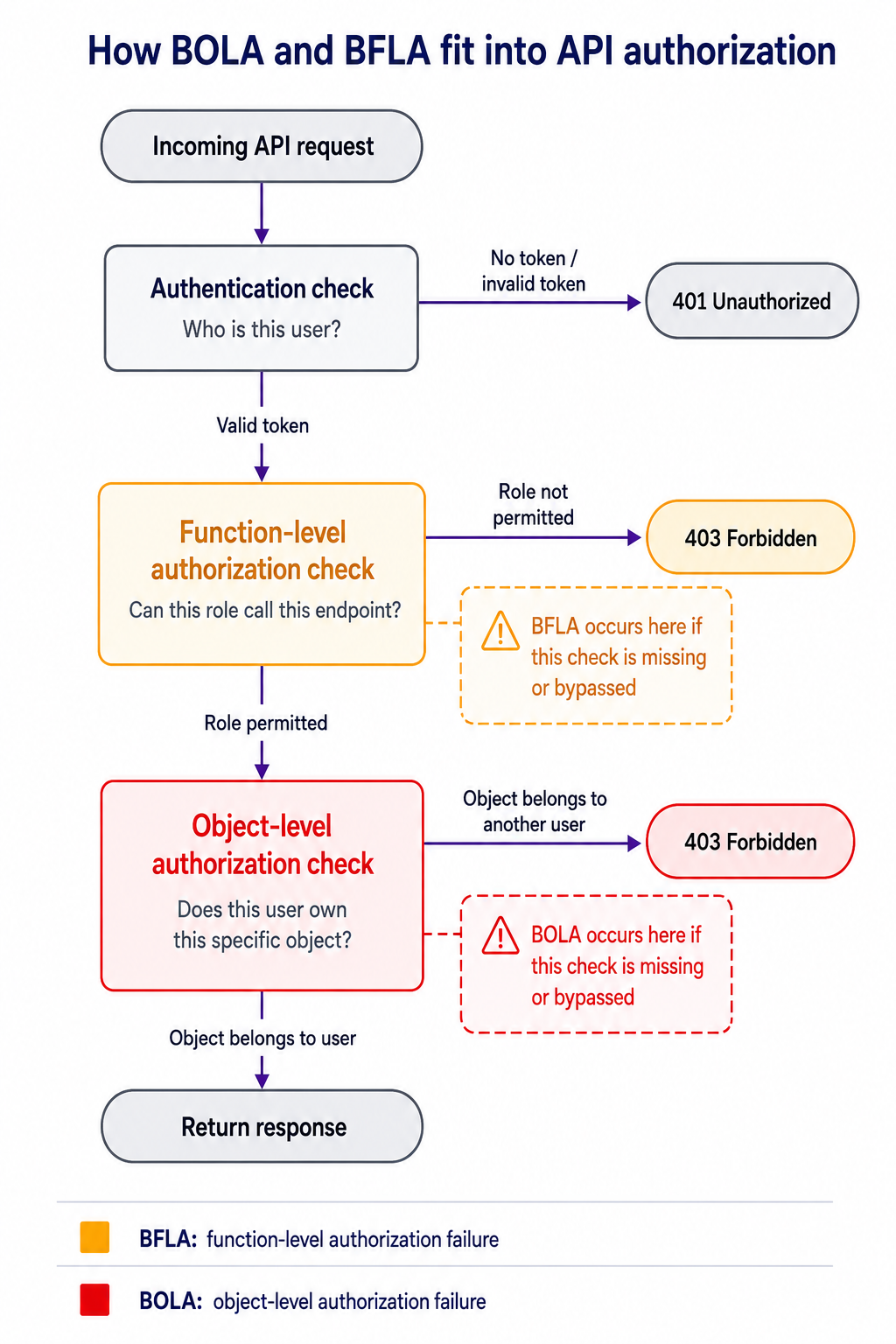
OWASP makes this boundary explicit. In BOLA, the user is expected to access the endpoint – the violation happens at the object level by design. If a user can reach a function they should not be able to call at all, that is BFLA.
In practice, this means BFLA is a role enforcement problem, while BOLA is a data ownership enforcement problem. Fixing one layer does not automatically address the other.
BOLA vs BFLA: Side-by-side attack pattern comparison
BOLA in action: The object ID manipulation pattern
Scenario: An API exposes order data by ID:
GET /api/orders/1001
Authorization: Bearer USER_A_TOKEN
An attacker requests a different ID:
GET /api/orders/1002
Authorization: Bearer USER_A_TOKEN
The only change between these two requests is the object identifier. The user remains the same, but the API returns data for a different user.
This is BOLA. The user is authorized to call the endpoint itself, but the API fails to verify ownership of the object. A secure API should return a 403 or equivalent error when the object does not belong to the authenticated user.
BOLA vulnerabilities are typically discovered and exploited by manipulating identifiers – incrementing numeric IDs, swapping UUIDs, or replaying requests across user sessions. The same methods are used by pentesters and scanners to detect BOLA in APIs.
This pattern has appeared in real-world incidents. In the 2024 Spoutible breach, authenticated API requests exposed other users’ sensitive data because object-level authorization checks were missing.
BFLA in action: The function invocation pattern
Scenario: An administrative endpoint allows a regular user to send a request to delete a record by ID:
DELETE /api/admin/users/456
Authorization: Bearer STANDARD_USER_TOKEN
The request is valid at the protocol level, but it targets a function that should be restricted to higher-privilege roles.
This is BFLA. The user should not be able to invoke the function at all. A secure implementation would block this request before execution based on the user’s role.
BFLA vulnerabilities are typically discovered by enumerating endpoints and testing access from lower-privilege accounts – especially admin paths, internal APIs, and undocumented HTTP methods.
HTTP method BFLA: The hidden exposure pattern
GET /api/documents/doc-123
Authorization: Bearer USER_TOKEN
→ 200 OK

DELETE /api/documents/doc-123
Authorization: Bearer USER_TOKEN
→ 200 OK
The same resource is protected for read access but exposed for deletion.
The API enforces authorization for read operations but fails to apply the same controls to destructive methods. Authorization must be enforced consistently across all HTTP methods, not just GET. Method-level inconsistencies like this are a common source of BFLA.
Role self-modification BFLA: The privilege escalation pattern
PUT /api/users/me
Authorization: Bearer USER_TOKEN

{"role":"admin"}
This allows a standard user to directly modify a security-sensitive field that should never be user-controlled.
The critical impact is not the response itself, but that subsequent requests now execute with elevated privileges, confirming the role change has been applied.
When BOLA and BFLA combine: The chained attack
In real applications, BOLA and BFLA often reinforce each other rather than appearing in isolation.
Chain pattern 1: BOLA enables BFLA
In this scenario, BOLA exposes sensitive information, and BFLA uses it to escalate privileges.
In step 1, BOLA exposes sensitive identifiers:
GET /api/users/1050
Authorization: Bearer USER_TOKEN
{"userId":1050,"role":"admin"}
In step 2, BFLA uses that information:
POST /api/admin/impersonate
Authorization: Bearer USER_TOKEN
{"targetUserId":1050}
Chain pattern 2: BFLA enables BOLA at scale
Here, BFLA provides bulk access, and BOLA turns it into large-scale data extraction.
In step 1, BFLA exposes bulk data:
GET /api/admin/users
Authorization: Bearer USER_TOKEN
In step 2, BOLA exploits it. An attacker can iterate through all user IDs and extract data from endpoints that lack object-level validation.
Real-world incidents often involve multiple authorization failures across the same API surface. In 2025, a vulnerability chain in ZITADEL’s Admin API (CVE-2025-27507) allowed authenticated low-privilege users to manipulate LDAP authentication settings and other sensitive configuration. The issue stemmed from insufficient authorization checks across multiple admin endpoints, combining object-level and function-level authorization gaps in a single attack surface.
Testing for BOLA vs BFLA: Different methodology, same authenticated scanner
Testing API authorization requires simulating how different users interact with the same system.
What BOLA testing requires
- Multiple users at the same privilege level
- Cross-session substitution of object identifiers
- Validation that users cannot access each other’s data
What BFLA testing requires
- Multiple roles with different permissions
- Attempts to access restricted endpoints
- Systematic testing of all HTTP methods
The combined testing matrix
Each row in the table below represents a concrete test case combining user role, request scenario, and expected authorization outcome.
Given that most API attacks originate from authenticated sessions, multi-user and multi-role testing is essential. Authentication alone does not prevent abuse – it enables it when authorization is weak.
Why Invicti tests both for BOLA and BFLA
Invicti’s API DAST scanner tests both layers in a single workflow:
- Multi-session testing to detect BOLA
- Multi-role testing to detect BFLA
- Proof-based validation to confirm exploitability
This ensures teams focus on real, exploitable risk rather than theoretical findings.
BOLA and BFLA prevention: Different patterns for each vulnerability
In practice, effective API security requires both layers to be implemented together. Object-level authorization controls which data a user can access, while function-level authorization controls what actions they are allowed to perform.
These controls are often owned by different teams. Object-level authorization is typically implemented in backend data access code, while function-level authorization is enforced in middleware or API gateways. When these responsibilities are split, gaps emerge – one layer is implemented correctly while the other is overlooked.
A single endpoint can require both layers of protection. Function-level checks verify that a user is allowed to perform an action, while object-level checks ensure they are acting on the correct data.
BOLA prevention
This example shows how object-level authorization is enforced directly in the data query:
order = Order.objects.get(id=order_id, user=request.user)By including the current user in the query, the application ensures that only objects owned by that user can ever be retrieved.
To prevent BOLA in APIs, object-level authorization must be enforced at the data layer by scoping queries to the current user or tenant.
Common failures include:
- Fetching objects by ID without user context
- Performing checks after data retrieval
- Relying on client-side validation
BFLA prevention
This example shows how function-level authorization is enforced before the endpoint logic runs:
@require_role('admin')
def delete_user(request, user_id):
The decorator blocks access unless the user has the required role, preventing unauthorized function execution.
Function-level authorization must be enforced before execution, typically through middleware or decorators tied to roles.
Common failures include:
- Missing role checks on specific endpoints
- Inconsistent enforcement across HTTP methods
- Allowing sensitive fields to be modified without restriction
Test your APIs for both BOLA and BFLA – and more
BOLA and BFLA are two sides of the same problem: incomplete authorization. Testing for only one leaves critical gaps, and manual approaches rarely cover both dimensions consistently.
Invicti’s API DAST scanner tests object-level and function-level authorization in a single authenticated API testing workflow. By combining multi-user and multi-role testing with proof-based validation, it confirms which vulnerabilities are really exploitable – not just theoretically possible.
This allows security and development teams to focus on fixing verified issues, reduce false positives, and ensure authorization controls are enforced across both data access and function execution.
See how Invicti helps you discover APIs and test API authorization end-to-end – request a demo to see modern API DAST in action.
Frequently asked questions
FAQs about BOLA vs BFLA
BOLA is a horizontal access control issue between users of the same role. BFLA is a vertical issue where lower-privilege users can access higher-privilege functions.
Neither is inherently more dangerous – they create different risks. BOLA is more common and leads to data exposure, while BFLA can enable full privilege escalation and system-level impact.
IDOR is the general case of exposing direct object references without enforcing access control. BOLA is the API-specific form of IDOR, focused on missing object-level authorization checks in API endpoints.
Yes. An endpoint can allow unauthorized function access and fail to validate object ownership, requiring both controls to be implemented.
BOLA requires multi-user testing to verify data isolation, while BFLA requires multi-role testing to verify access control. A complete approach tests both dimensions together to ensure users can only access the right data and the right functions.
Horizontal escalation (BOLA) accesses other users’ data at the same privilege level, while vertical escalation (BFLA) accesses higher-privilege functions.
BOLA can expose identifiers or sensitive data that make privilege escalation via BFLA more effective. For example, discovering admin user IDs or configuration details can enable targeted abuse of privileged functions.
It occurs when an endpoint restricts some methods but not others, allowing unauthorized actions like DELETE or PUT. This is a common implementation gap in REST APIs.
Invicti uses authenticated, stateful, multi-session API DAST scans with multi-user and multi-role testing, validating findings with proof-based evidence.
Experience the future of AppSec
