
Shift-left API security: From reactive testing to continuous assurance
API vulnerability exploitation grew by 181% in 2025 – a striking reminder that attackers increasingly see APIs as one of the fastest paths to sensitive data and business-critical functionality. At the same time, API adoption continues to accelerate. According to KuppingerCole research, 92% of organizations increased API usage over the previous year, with many managing hundreds or even thousands of undocumented or unmonitored shadow APIs.
For security leaders, the challenge is no longer finding vulnerabilities – it is maintaining confidence across an attack surface that changes continuously.
The traditional answer has been to shift left by integrating security testing earlier into the software development lifecycle so vulnerabilities are identified before deployment. This approach delivers clear benefits. Security findings reach developers when fixes are easier, cheaper, and less disruptive. Security teams gain visibility earlier in the release process. Vulnerabilities are prevented from accumulating into production security debt.
But shifting left is not enough to solve the API security problem.
APIs are dynamic systems. New endpoints appear, existing services evolve, third-party integrations change, and infrastructure modifications create new exposure. Development teams introduce new functionality at a pace that often outstrips documentation and governance processes.
A shift-left program validates what was deployed. A continuous assurance program validates what exists today.
This distinction is increasingly important because most organizations still struggle with API visibility and detection. According to Traceable’s State of API Security research, only 21% of organizations report a high ability to detect attacks at the API layer. Even organizations with mature CI/CD pipelines often discover that they lack confidence in the completeness of their API inventory or the coverage of their testing processes.
This guide explores the evolution from reactive API security to proactive shift-left practices and ultimately to continuous assurance. It also explains why continuous assurance has become the logical next step for organizations that want to maintain visibility and control across an API ecosystem that never stops changing.
Shift left API security and continuous assurance defined
Shift left API security is the practice of integrating API security testing into the earliest stages of the software development lifecycle, including design reviews, code repositories, CI/CD pipelines, and staging environments, rather than relying primarily on testing before release or after deployment.
Continuous API security assurance extends this model by combining shift-left testing with ongoing API discovery, continuous validation, production testing, risk prioritization, and security oversight throughout the API lifecycle. Rather than treating security as a series of isolated checkpoints, continuous assurance treats security as an ongoing process of verification.
In this context, shift right refers to maintaining visibility and validation after deployment rather than treating release as the end of the security process.
The three stages of API security maturity
Most API security programs exist somewhere on a maturity continuum. Understanding where your organization sits today – and what the next stage requires – is often the starting point for strategic improvement.
The progression is not so much about adding more tools as it is about improving visibility, reducing uncertainty, and building confidence in security decisions.
Stage 1: Reactive API security
In a reactive security model, testing is largely event-driven. Annual penetration tests, pre-release security reviews, and ad hoc vulnerability assessments form the foundation of the security program. Security teams own the process and developers engage primarily when findings need remediation.
For many organizations, this model evolved naturally from traditional web application security practices. It worked reasonably well when applications changed infrequently and deployment cycles were measured in months rather than days. Modern APIs have changed that equation.
A reactive security model can identify vulnerabilities that exist at the time of assessment, but it struggles to keep pace with continuous change. New endpoints appear between testing cycles, existing APIs gain functionality, development teams deploy services that were never included in the original assessment scope, and third-party integrations continuously expand the attack surface.
The result is a growing gap between what security teams think they are protecting and what actually exists and is exposed in production.
What reactive security finds
- Vulnerabilities present during the assessment window
- Common implementation flaws in known APIs
- Security issues identified through manual testing
- Vulnerabilities in assets included within the testing scope
What reactive security misses
- APIs introduced after the assessment
- Shadow APIs outside governance processes
- Authorization flaws in endpoints that were never tested
- Configuration changes made after deployment
- Risks introduced through evolving third-party integrations
The cost implications are equally significant. Security debt accumulates because vulnerabilities remain undiscovered longer, remediation requires more coordination, and operational teams become involved in validation and deployment activities. Industry estimates typically place production-stage remediation costs at $50,000 or more per finding once investigation, validation, coordination, and operational effort are included.
Organizations operating primarily in Stage 1 often believe they have visibility because testing occurs periodically. In practice, visibility decreases every day between assessments.
Stage 2: Proactive API security (shift left)
Shift left fundamentally changes the timing of security validation. Instead of waiting until release time, organizations integrate security directly into software delivery workflows so API testing becomes part of development rather than a separate downstream activity.
Security scans run automatically within CI/CD pipelines, findings are routed directly into developer workflows, and quality gates help prevent critical vulnerabilities from reaching production. As a result, developers receive feedback closer to the point where vulnerabilities are introduced, security teams spend less time managing downstream incidents, and remediation costs decrease because issues are resolved before deployment.
The benefits are measurable. Semgrep’s analysis of more than 50,000 repositories found that organizations resolved security findings approximately nine times faster when issues were identified during pull-request review rather than through later-stage scans.
The closer security findings are delivered to the moment a vulnerability is introduced, the faster teams can respond and the lower the operational cost of remediation becomes.
Why DAST becomes foundational
For API security specifically, shift-left practices enable capabilities that are difficult to achieve through periodic testing alone. Authenticated API testing can validate authorization controls before deployment, while multi-user testing can identify vulnerabilities such as BOLA and BFLA before they reach production. Security controls can also be tested repeatedly as APIs evolve rather than only during major assessment events.
This is where dynamic application security testing (DAST) begins to play a foundational role. Static analysis can identify potentially vulnerable code, specification reviews can identify design weaknesses, and software composition analysis can identify vulnerable dependencies. However, APIs are ultimately running systems.
DAST provides visibility into how APIs behave when they are actually deployed and responding to requests. It validates real execution paths, authentication flows, business logic, and authorization controls. This runtime perspective helps security teams focus on exploitable risk rather than theoretical possibilities.
These capabilities significantly improve coverage compared to reactive security, but they remain focused on what enters the deployment pipeline.
What proactive security finds
- Vulnerabilities introduced through new code changes
- Authentication and authorization weaknesses in staging
- BOLA and BFLA issues identified through authenticated testing
- Vulnerabilities discovered before deployment
What proactive security misses
- APIs that exist outside the CI/CD process
- Shadow APIs introduced through alternative workflows
- Changes made after deployment
- Infrastructure-driven exposure changes
- Risks introduced through evolving third-party dependencies
Shift left can greatly improve prevention, but it still relies on a fundamental assumption: that what was tested before deployment accurately represents what exists after deployment. As API ecosystems grow in scale and complexity, that assumption becomes increasingly difficult to maintain.
Stage 3: Continuous API security assurance
Continuous assurance builds on shift left rather than replacing it. Organizations in Stage 3 continue to validate APIs during development and deployment, but they extend that validation across the entire lifecycle.
The objective shifts from finding vulnerabilities to maintaining confidence. Security leaders want answers to questions such as:
- Do we know about every API that exists today?
- Are our testing processes aligned with the current attack surface?
- Have recent changes introduced new risk?
- Are developers focused on the vulnerabilities that matter most?
Answering those questions requires more than CI/CD testing. It requires continuous API discovery to maintain visibility into the attack surface, ongoing validation to confirm that deployed environments match expectations, and centralized risk prioritization so security teams can focus attention where it creates the greatest impact.
Most importantly, it requires security signals to work together. Discovery without testing creates inventory but not assurance. Testing without discovery creates coverage gaps, while prioritization without validation creates noise. Assurance emerges when discovery, testing, validation, and remediation operate as a coordinated system.
Why validation matters
DAST plays a crucial role in this model by evaluating APIs as attackers see them – in execution, through real requests, authentication flows, business logic, and authorization controls. As a result, it serves as a validation layer for the broader security program, helping teams distinguish exploitable risk from theoretical risk and ensuring that discovery, prioritization, and remediation decisions are grounded in the reality of how applications behave when they are running.
What continuous assurance adds
- Live API inventory: Continuous discovery keeps inventories aligned with reality by identifying new, changed, unmanaged, and undocumented APIs as they appear. This includes shadow APIs created outside formal governance processes and zombie APIs that remain exposed despite no longer serving a business purpose.
- Post-deployment validation: Scheduled testing of production environments helps identify configuration drift, newly exposed endpoints, and security weaknesses introduced after deployment. The goal is not to replace shift-left testing but to confirm that production environments continue to match the assumptions validated earlier in the lifecycle.
- Third-party API awareness: Modern applications increasingly depend on external APIs. Authentication methods change, schemas evolve, and integrations expand. Continuous assurance helps organizations understand when those changes create new risk and whether existing security assumptions remain valid.
- Compliance evidence generation: Continuous testing and validation create a documented record of security activities over time. This provides stronger evidence for compliance frameworks that increasingly emphasize ongoing security validation rather than point-in-time assessments.
Maturity stages of API security at a glance
Why shift left is not enough – the production gap
Shift left addresses many of the weaknesses of reactive security, but it does not eliminate the production gap. Three common drivers of change illustrate why the gap persists.
AI-assisted development accelerates API growth
Development teams can now generate services, routes, and endpoint definitions faster than ever. AI-assisted development improves productivity, but it also increases the likelihood that APIs appear faster than documentation, inventory management, and governance processes can keep pace.
Security testing can only validate assets it knows about. Discovery remains essential because organizations cannot secure APIs they do not know exist.
Third-party services evolve after deployment
Most modern applications rely on external APIs that are subject to rapid change as much as the apps themselves. Authentication mechanisms change. Response structures evolve. New capabilities appear. Existing functionality is deprecated.
A deployment-time validation may accurately represent conditions on release day, but external services continue to evolve afterward.
Continuous assurance extends visibility beyond the deployment event so organizations can understand how those changes affect risk over time.
Infrastructure changes create exposure without code changes
Not every security change originates in source code. Network policy modifications, Kubernetes configuration changes, cloud infrastructure updates, and load balancer adjustments can all alter API exposure without triggering a deployment pipeline.
A shift-left control may never see those changes. Lifecycle validation helps organizations assess what is actually deployed rather than relying exclusively on assumptions established during earlier stages of development.
Building the continuous assurance model – a phased roadmap
Continuous assurance is a maturity journey rather than a single product or process implementation.
Phase 1 – Moving from reactive to proactive (0–6 months)
The foundation for Phase 1 is reliable security validation within software delivery pipelines. Priority actions at this stage include:
- Deploy API DAST scanning in staging environments
- Trigger testing automatically on every deployment
- Configure risk-based quality gates
- Route findings into developer workflows
- Establish authenticated multi-user testing for authorization validation
- Measure baseline remediation metrics and MTTR
The primary objective is preventing new vulnerabilities from reaching production. A successful Phase 1 implementation results in consistent security validation across every deployment cycle and establishes a repeatable foundation for future maturity.
Milestone: Every staging deployment automatically triggers API security testing, and confirmed critical vulnerabilities are prevented from reaching production.
Phase 2 – Extending left: design and development (3–9 months)
With CI/CD testing established, organizations can push security earlier into the lifecycle. Priority actions include:
- OpenAPI specification validation and linting
- Repository-based API discovery
- Authorization model reviews during design
- Early identification of new endpoints and services
- Developer-focused security guidance
This phase is particularly important for preventing authorization issues such as BOLA and BFLA before they become implementation problems. Rather than discovering authorization weaknesses during testing, teams begin validating authorization assumptions during design and development.
The result is lower remediation cost and faster developer feedback.
Milestone: New APIs receive security review and validation before implementation begins, reducing the likelihood of authorization flaws and undocumented endpoints entering production.
Phase 3 – Extending assurance across production (6–18 months)
The final phase focuses on maintaining confidence and coverage after deployment. Priority actions include:
- Continuous API discovery from multiple sources
- Scheduled validation of production environments
- Identification of new and unmanaged APIs
- Monitoring of third-party API dependencies
- Centralized risk visibility through ASPM capabilities
- Compliance evidence collection and reporting
The goal at this stage is ensuring that discovery, testing, validation, prioritization, and remediation remain aligned with the actual attack surface.
Organizations achieve continuous assurance for API security when security leaders can confidently answer three questions:
- What APIs do we have?
- Which risks matter most?
- How quickly can we validate and remediate them?
Milestone: Production API inventory, testing coverage, and risk visibility remain continuously aligned with the live attack surface.
Shift left plus shift right: The API security continuous assurance architecture
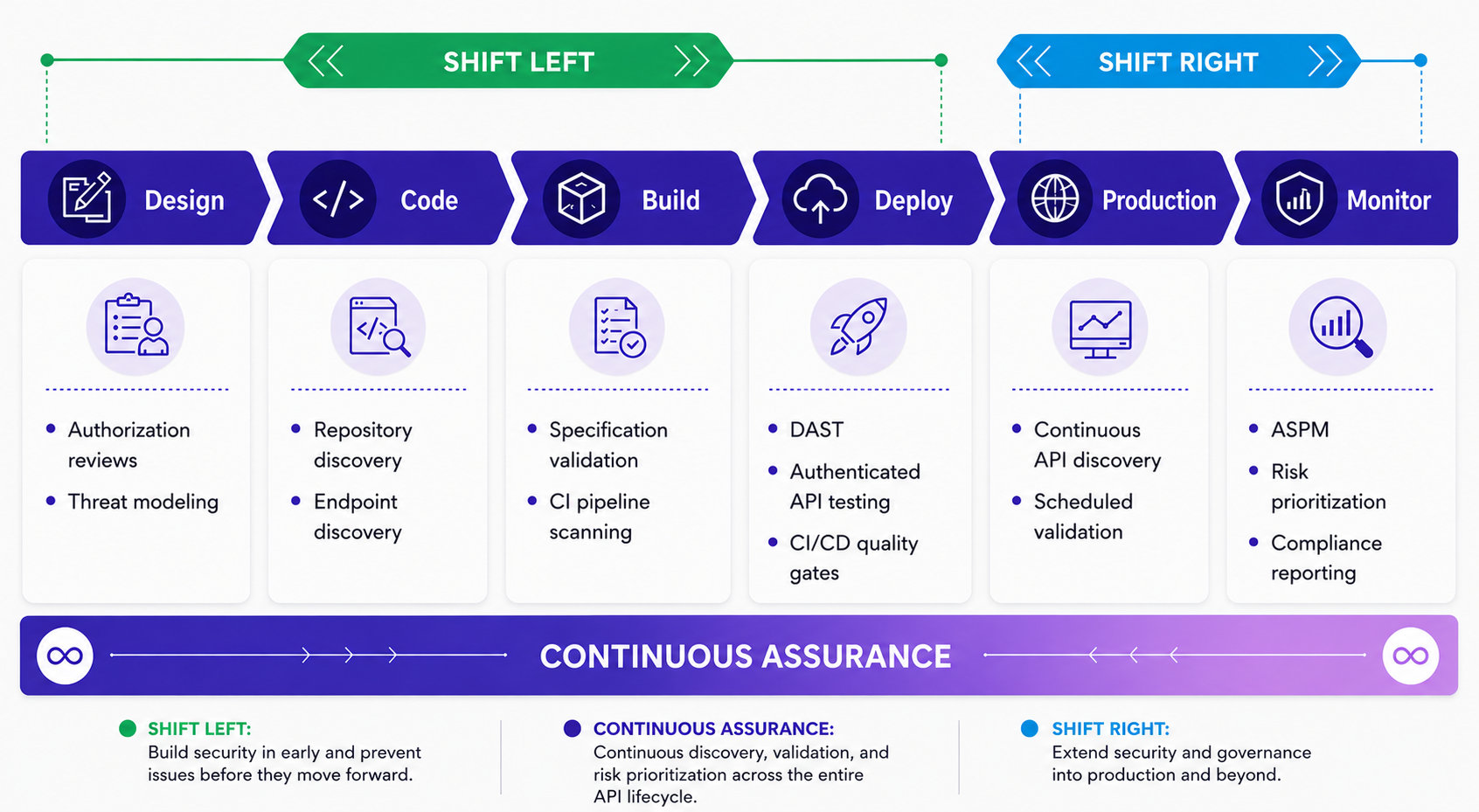
Industry discussions increasingly frame API security as “shift left plus shift right.” Continuous assurance extends that idea by connecting discovery, testing, validation, prioritization, and remediation into a single operating model.
The result is greater confidence because security decisions are informed by current runtime reality rather than assumptions established earlier in the pipeline. Discovery keeps inventories current, DAST validates real application behavior, and ASPM helps teams focus on the risks that matter most.
Metrics for each maturity stage
When implementing a phased transition across months or years, security leaders need measurable indicators of progress.
Metrics for the Stage 1 → Stage 2 transition
- Scan coverage rate: Target 100% of staging deployments
- Time from vulnerability introduction to detection: Target hours to days instead of weeks or months
- Percentage of findings identified before production deployment: Target greater than 80%
- Mean time to remediation: Trend downward with every release cycle
The objective is reducing the delay between vulnerability introduction and vulnerability discovery.
Metrics for the Stage 2 → Stage 3 transition
- API inventory freshness: Target full production inventory visibility within 24 hours of deployment
- Production validation frequency: Target continuous visibility with scheduled testing at least weekly or monthly
- Third-party API coverage: Target visibility into all consumed external APIs, with visibility into authentication and schema changes that may affect security posture
- Percentage of findings validated and prioritized: Maximize developer focus on actionable risk
The objective shifts from measuring testing activity to measuring confidence in coverage.
The business case for continuous assurance
The strongest business argument in favor of continuous assurance is economic.
The economics of API security are driven largely by when vulnerabilities are discovered. Every vulnerability discovered earlier costs less to fix. Every visibility gap eliminated reduces operational risk. Every validated finding reduces time spent investigating noise.
While exact remediation costs vary between organizations, industry research consistently shows that vulnerabilities become exponentially more expensive to address the later they are discovered.
Continuous assurance also addresses a different economic challenge. The largest costs often emerge not because testing failed but because assumptions became outdated:
- A security team believed an API inventory was complete.
- A development team assumed a third-party integration had not changed.
- An infrastructure change altered exposure without triggering validation.
Continuous assurance reduces these risks by continuously verifying assumptions.
The compliance benefits are equally important. PCI DSS 4.0 requirements became fully effective on March 31, 2025, and emphasize ongoing testing and vulnerability management activities. DORA similarly places greater emphasis on continuous monitoring, resilience, and security validation. Organizations that build continuous assurance programs are simultaneously building the evidence base needed to demonstrate compliance with increasingly demanding regulatory requirements.
Assurance goes beyond just demonstrating that security testing happened – it shows that security remains effective as systems evolve.
Conclusion: Build an API security program that keeps pace with your attack surface
Shift left catches vulnerabilities before deployment. Continuous assurance validates security throughout the lifecycle.
As API ecosystems continue to grow in scale and complexity, organizations need confidence that their security controls remain aligned with a constantly changing attack surface.
Invicti helps organizations build that model through multilayered API discovery, continuous DAST testing, authenticated API testing and validation, CI/CD integration, proof-based findings, and centralized application security visibility.
Together, these capabilities provide a practical path from reactive security to continuous assurance – helping security and development teams focus on exploitable risk, maintain confidence in their API inventory, and continuously validate the security posture of an evolving attack surface.
Next steps:
- Explore how developer-led API security supports continuous assurance
- Request a demo of integrated API discovery and testing on the Invicti Platform
Frequently asked questions
Frequently asked questions about continuous API security assurance
Shift left API security integrates security testing into development and deployment workflows rather than waiting until release or production. Common practices include automated API testing in CI/CD pipelines, authenticated DAST scanning in staging environments, and security validation before deployment. The goal is to identify vulnerabilities when they are easier, faster, and less expensive to fix.
Shift left focuses on identifying and addressing vulnerabilities before deployment. Shift right extends security visibility and validation into production through activities such as API discovery, production testing, and change monitoring. Continuous assurance combines both approaches into a lifecycle-wide model that continuously validates security posture as APIs evolve over time.
Shift left validates APIs before deployment, but APIs continue to change afterward. New endpoints can appear, third-party integrations can evolve, infrastructure changes can alter exposure, and shadow APIs can emerge outside standard development workflows. These changes may not be visible to pre-deployment testing, which is why continuous discovery and post-deployment validation are essential components of a mature API security program.
DAST supports continuous assurance by validating APIs as they actually run. While discovery identifies what exists and other testing methods identify potential weaknesses, DAST evaluates real requests, authentication flows, business logic, and authorization controls. This helps security teams distinguish exploitable risk from theoretical risk and provides a validation layer across the API lifecycle.
The cost of remediation increases significantly as vulnerabilities move through the software development lifecycle. Industry estimates place remediation costs per issue at several hundred dollars during development and $50,000 or more after production deployment, with costs increasing dramatically if a vulnerability contributes to a breach. IBM’s 2025 Cost of a Data Breach Report found an average breach cost of $4.44 million globally, highlighting the value of identifying and validating vulnerabilities as early as possible.
Continuous API security assurance supports compliance initiatives that require ongoing testing, monitoring, and evidence collection. Examples include PCI DSS 4.0, DORA, and evolving healthcare security requirements. Because assurance programs continuously generate testing, remediation, and validation records, they help organizations demonstrate compliance without relying exclusively on point-in-time assessments.
Experience the future of AppSec
