
Agentic pentesting for healthcare: Deeper testing with defensible evidence
Healthcare applications increasingly connect patients, clinicians, partners, and sensitive health data through complex web and API workflows. Patient portals, clinical applications, electronic health record (EHR) integrations, healthcare SaaS, and APIs all need meaningful security testing, but healthcare organizations in particular need to protect system availability and avoid unnecessary exposure of sensitive information.
Agentic pentesting can add deeper, adaptive testing between periodic manual assessments – but AI-driven exploration needs runtime validation, controlled testing, and evidence that security teams and developers can trust.

How can healthcare organizations use agentic pentesting?
Healthcare organizations can use agentic pentesting to extend deeper application and API testing across patient portals, clinical web applications, healthcare SaaS, and other high-risk systems. The strongest approach combines agentic reasoning with runtime security testing so adaptive exploration can identify complex attack paths while candidate vulnerabilities are validated before reaching security and development teams.
This gives healthcare teams another layer between broad automated testing and resource-intensive human assessments.
Why is penetration testing different in healthcare?
Healthcare penetration testing must account for highly sensitive health information, complex user roles, extensive integrations, mixed application estates, and demanding availability requirements. A vulnerability can expose patient information, affect access to clinical data, disrupt healthcare operations, or create broader risk through connected applications and APIs.
Sensitive data raises the stakes
Healthcare applications can process diagnoses, medications, laboratory results, insurance information, treatment records, appointments, authentication credentials, and other sensitive information.
In the US, the Health Insurance Portability and Accountability Act (HIPAA) Security Rule requires regulated entities to assess risks and vulnerabilities affecting the confidentiality, integrity, and availability of electronic protected health information (ePHI). Application security testing can support these broader HIPAA application security requirements and risk-management activities, but no individual security test or tool establishes regulatory compliance by itself.
Identity and APIs create complex attack paths
Healthcare applications may need to distinguish among patients, clinicians, administrators, insurers, laboratories, pharmacies, partner organizations, and service accounts.
At the same time, APIs increasingly connect patients and providers with EHRs, laboratories, pharmacies, payers, and external services. A security failure may therefore depend on relationships among identities, data objects, endpoints, and systems rather than one isolated request.
Availability changes the testing risk model
Testing a patient portal, clinical application, scheduling system, or provider workflow can carry different operational consequences from testing an ordinary business application.
In healthcare, application availability can be a security and patient-care concern at the same time.
Deeper testing is valuable, but testing itself needs controls proportionate to the application and potential consequences.
How agentic pentesting adds another layer of testing depth
Dynamic application security testing (DAST) provides systematic, repeatable runtime testing across web applications and APIs. Human penetration testers add adaptive reasoning, specialist knowledge, and contextual judgment. The challenge is balancing the two to apply enough depth across a large and changing healthcare application estate.
Periodic human assessments provide valuable point-in-time assurance, but applications keep changing between engagements. Authentication changes, new APIs appear, partner integrations expand, workflows evolve, and vulnerabilities are remediated.
Agentic pentesting can add deeper, adaptive testing between those periodic assessments without requiring specialist effort to grow in direct proportion to the application estate.
Testing when risk changes, not only when the calendar says so
A high-risk application might receive a human penetration test and continuous DAST, with additional agentic assessments triggered by meaningful changes. A new FHIR API, authentication redesign, patient workflow, partner integration, or significant remediation can all justify deeper reassessment.
Healthcare applications should not have to wait until the next scheduled human engagement to receive deeper testing after their risk changes.
What agentic pentesting adds to healthcare security testing
Agentic pentesting uses autonomous AI agents to make testing decisions based on what they discover about an application. Agents can maintain context, formulate security hypotheses, and adapt subsequent tests to observed behavior.
That capability is useful where security depends on application-specific relationships rather than isolated vulnerability checks.
Adaptive testing follows application context
Consider an account-recovery workflow. Each individual request might appear secure when tested independently, yet an unexpected sequence could allow one user to interfere with another account.
An agent can observe the workflow, reason about its state, develop a hypothesis, and investigate it with application-specific tests. The same approach can apply to authorization boundaries, tenant isolation, provider-only functions, and other business logic.
Healthcare APIs make context especially important
Suppose an authenticated patient requests their medical results:
/api/patient/123/results
A pentesting agent can observe the patient identifier and test whether authorization is tied correctly to the authenticated identity by making an approved request for a different controlled patient object:
/api/patient/124/results
At this point, the important question is whether the running API correctly denies access upon receiving the request. If it returns another patient’s record, the test has demonstrated broken object-level authorization (BOLA). If it refuses access, the BOLA hypothesis is disproved.
Testing healthcare APIs often requires this kind of context because authorization depends on identity, object ownership, roles, application state, endpoint relationships, and multi-step workflows. This makes agentic pentesting for APIs especially valuable for healthcare.
Why does runtime validation matter for healthcare?
Runtime validation separates a plausible AI-generated security hypothesis from a demonstrated vulnerability. For healthcare teams, that distinction helps prevent speculative findings from consuming scarce AppSec and development resources while providing technical evidence for vulnerabilities that are actually exploitable.
Separating vulnerability discovery from confirmation
A reliable agentic testing process should have a clear trust flow:
- Agentic AI explores, reasons, and adapts.
- Runtime testing confirms whether the suspected weakness is exploitable.
- A confirmed finding provides evidence developers can reproduce.
- Remediation can then be retested to verify the fix.
Invicti Agentic Pentest follows this separation between adaptive investigation and runtime confirmation. Candidate vulnerabilities are validated before they are reported as confirmed Agentic Pentest findings.
Proof reduces noise as well as security risk
AI can generate security hypotheses quickly. If every hypothesis becomes a vulnerability ticket without checking whether it’s valid, intensifying test automation merely creates more verification work for humans.
Runtime evidence provides a reliable basis for prioritization. Depending on the finding, that evidence can include the affected endpoint, authentication context, payload, request and response, reproduction guidance, and remediation information.
For healthcare AppSec, proof reduces two risks at once: the risk of missing exploitable vulnerabilities and the operational risk of overwhelming teams with AI-generated noise.
How to keep agentic testing controlled in healthcare
Agentic testing should operate within explicit boundaries, especially when applications process sensitive information or support important healthcare workflows. The ability to automate testing does not mean every possible test should run against every production system.
Constrain scope, identities, traffic, and sensitive actions
Healthcare organizations should define which applications, APIs, hosts, and environments are approved for testing. Dedicated test identities can help examine patient, provider, administrative, and other authorization boundaries without unnecessarily relying on real users.
Request rates, execution time, and state-changing behavior should also be controlled. Actions involving clinical records, prescriptions, appointments, billing, privileges, or downstream systems may need to be excluded, constrained, or subjected to human oversight.
Invicti Agentic Pentest includes controls such as network-level scope enforcement, rate limiting, non-destructive payloads, execution limits, role-based access control (RBAC), and isolated execution.
Apply stricter controls as consequences increase
Production testing decisions should be based on application criticality.
A patient-facing informational service and an application involved in a critical clinical workflow should not automatically receive the same testing policy. Higher-consequence applications may warrant tighter restrictions, production-like test environments, or greater human supervision.
A related principle applies to sensitive information, where testing should be able to prove exposure without unnecessarily increasing exposure.
Which healthcare applications should receive deeper testing?
Testing depth should reflect patient, data, and operational impact rather than treating every healthcare application identically. Patient portals, authenticated clinical applications, healthcare SaaS, identity services, connected APIs, and systems with complex roles or multi-step workflows are all potential candidates for agentic testing when their risk warrants additional depth.
A practical assurance model can use four broad levels:
- High-consequence clinical applications – use controlled DAST, carefully scoped agentic testing, and greater human oversight.
- Patient-facing applications and high-risk APIs – use continuous DAST with risk-based or change-triggered agentic testing.
- Administrative and standard applications – use DAST with risk-triggered deeper testing.
- Lower-risk applications – maintain baseline DAST coverage and increase testing depth when risk changes.
Prioritization should consider patient impact, ePHI sensitivity, identity complexity, internet exposure, API connectivity, change velocity, clinical importance, third-party dependencies, and how long it has been since the application received deeper assurance.
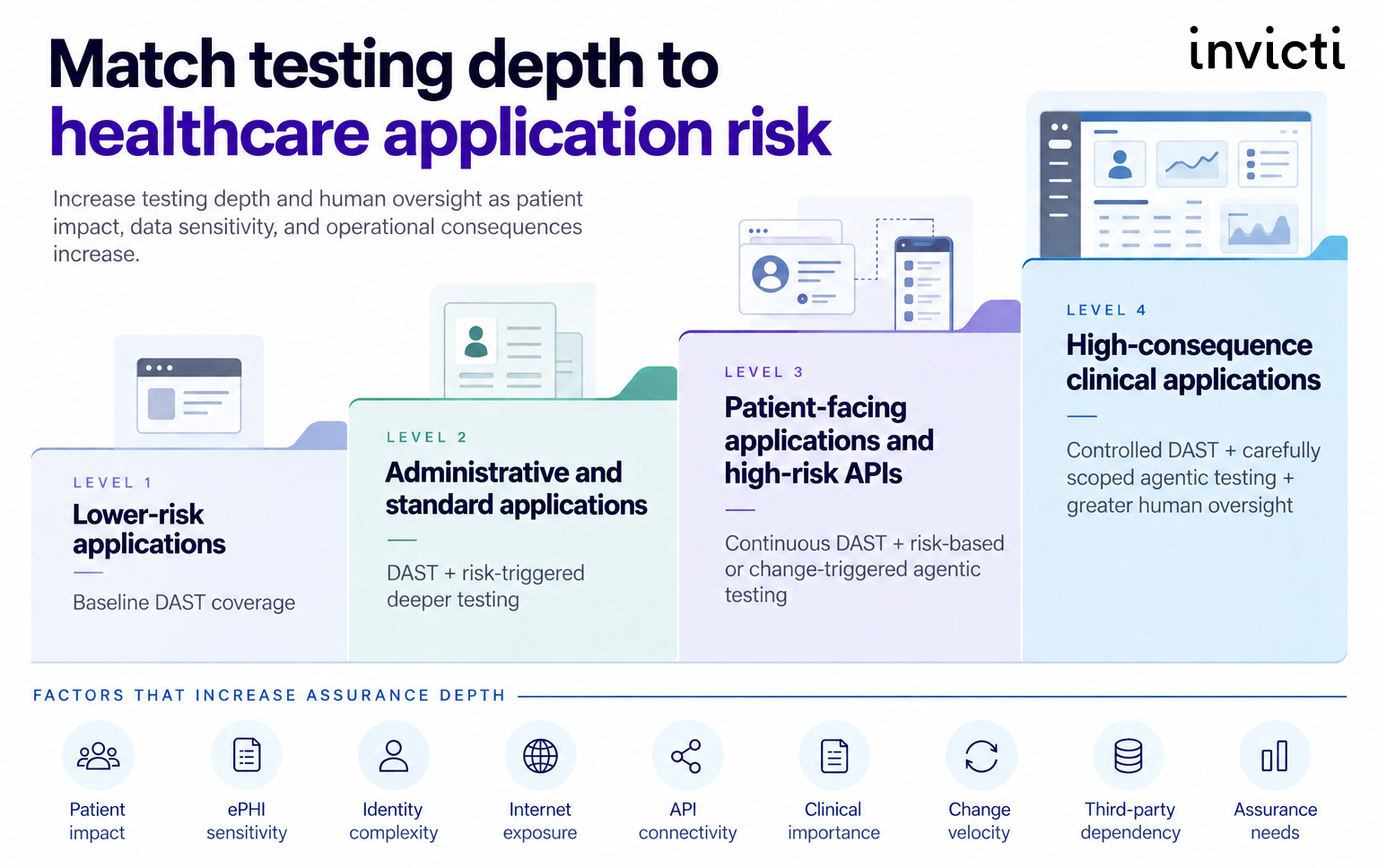
How DAST, agentic pentesting, and human expertise work together
Healthcare organizations do not need to choose between DAST, agentic pentesting, and human testing – those are complementary forms of application security assurance, and each brings something the others can’t.
DAST provides systematic runtime coverage
DAST provides repeatable testing against running applications and APIs, making it suitable for broad and continuous coverage across a healthcare application estate. It also provides the runtime foundation for agentic pentesting needed to verify whether candidate vulnerabilities are actually exploitable.
AI agents add adaptive investigation
Agentic testing adds application-specific reconnaissance and reasoning. Agents can adjust their tests based on technologies, authentication context, application behavior, and what earlier tests reveal. This extends deeper investigation to more applications without turning every assessment into a fully manual engagement.
Runtime proof turns investigation into actionable risk
Adaptive reasoning becomes operationally useful when findings are grounded in application behavior. Invicti combines agentic exploration with DAST-based runtime validation so candidate findings are confirmed before being reported as Agentic Pentest vulnerabilities. The result is evidence that security teams can prioritize and developers can investigate and remediate.
Human expertise remains part of the model
Human testers remain important for highly contextual clinical workflows, specialist assessments, unusual environments, independent assurance requirements, and scenarios where security decisions require human judgment. A risk-based healthcare program can therefore use broad DAST coverage, deeper agentic testing where risk warrants it, and specialist human testing where context or assurance requirements demand it.
Healthcare agentic pentesting evaluation checklist
When evaluating an agentic pentesting capability for healthcare, focus on whether the technology provides trustworthy depth rather than simply more autonomous activity.
Ask:
- Can it test authenticated patient-facing applications and APIs?
- Can it maintain context across roles, authorization boundaries, and multi-step workflows?
- Are candidate findings validated before they are reported as confirmed vulnerabilities?
- Does each confirmed finding provide evidence developers can reproduce and remediate?
- Can high-risk workflows, sensitive-data exposure, scope, and production behavior be constrained?
- How much analyst verification remains before findings can enter remediation workflows?
- Can findings support existing assurance, remediation, retesting, and developer workflows without implying automatic regulatory compliance?
For healthcare security teams, those questions get closer to operational value than simply asking how autonomous an AI testing product claims to be.
Scale healthcare penetration testing without sacrificing trust
Healthcare organizations need deeper application testing across growing estates of patient-facing applications, APIs, SaaS, integrations, and internal systems. They also need to protect availability, minimize unnecessary exposure of sensitive information, and avoid adding more unverified findings to already stretched security teams.
Agentic pentesting can help close that depth and coverage gap, but adaptive AI is only part of the answer.
Invicti Agentic Pentest combines autonomous AI agents with Invicti’s established DAST expertise and runtime validation. Agents can adapt testing to application behavior and investigate complex attack paths, while runtime confirmation turns successful investigation into evidence-backed findings.
That hybrid model lets healthcare organizations apply systematic DAST broadly, add deeper agentic testing according to risk and change, and retain human expertise where specialist judgment remains necessary.
For healthcare AppSec, the ultimate goal is deeper testing that produces risk teams can defend and developers can act on.
See runtime-validated agentic pentesting in action
See how Invicti combines adaptive agentic testing, DAST, and runtime validation to extend deeper, evidence-backed testing across web applications and APIs. Learn more about Invicti Agentic Pentest and request a demo to see it in action.
Frequently asked questions
Frequently asked questions about healthcare penetration testing
HIPAA does not prescribe one universal penetration-testing methodology for every covered entity or business associate. Penetration testing can support broader HIPAA security activities by identifying and validating application vulnerabilities, supporting risk assessment and reassessment, and verifying remediation. Testing alone does not establish HIPAA compliance.
For organizations subject to GDPR or NIS2, validated application security testing can contribute to broader risk-based security, vulnerability management, security evaluation, and effectiveness-assessment activities. The exact obligations differ between the frameworks and depend on organizational scope and applicable law. Running a penetration test does not by itself establish compliance with either GDPR or NIS2.
Potentially, but testing should become more tightly controlled as clinical and operational consequences increase. Scope, test identities, traffic rates, state-changing actions, sensitive-data access, and downstream effects all need consideration. Higher-risk scenarios may be better suited to production-like environments or greater human oversight rather than unrestricted autonomous testing.
Not universally. Human testers remain valuable for highly contextual clinical workflows, unusual environments, specialist assessments, independent assurance requirements, and scenarios where judgment about operational consequences is essential. Agentic pentesting can extend deeper testing across more applications and between manual engagements without eliminating those use cases.
Good candidates include patient portals, authenticated healthcare applications, healthcare SaaS, identity-sensitive services, and APIs where security depends on roles, authorization boundaries, application state, or multi-step workflows. Testing depth should follow risk, with greater assurance for systems handling sensitive data, supporting important clinical processes, or exposing complex external integrations.
Experience the future of AppSec
