
Agentic pentesting for APIs: Adaptive testing with validated results
Agentic pentesting for APIs uses autonomous AI agents to adapt security testing based on what an API reveals during an assessment. Rather than relying solely on predetermined checks, agents can use authentication context, endpoint relationships, application state, and previous results to generate targeted tests and pursue promising attack paths.
APIs are a natural fit for this approach because their security often depends on more than the behavior of a single endpoint. Identity, object ownership, roles, application state, request sequences, and relationships between endpoints can all determine whether an action should be allowed.
That makes API security a useful example of where agentic pentesting can extend established application security testing. Dynamic application security testing (DAST) provides broad, repeatable runtime testing, while agentic reasoning can investigate situations where the most effective next security test depends on what happened in the previous one.
The key is keeping that adaptive investigation grounded in runtime evidence.
Key takeaways
- APIs reward adaptive testing because security often depends on identities, objects, state, and relationships between requests.
- API DAST provides systematic runtime coverage, while agentic reasoning can formulate and pursue new hypotheses based on observed behavior.
- Agentic testing is especially useful for cross-endpoint investigation, authorization scenarios, and application-specific workflows.
- Runtime validation separates promising AI-generated hypotheses from confirmed vulnerabilities.
- Invicti Agentic Pentest combines adaptive, AI-driven investigation with Invicti’s DAST and runtime testing foundation, extending API security testing where deeper, application-specific exploration is useful.
What is agentic pentesting for APIs?
Agentic API pentesting uses autonomous AI agents to plan and adapt penetration testing actions against APIs based on what is observed during an assessment. Agents can interpret responses, preserve relevant context, generate targeted tests, change strategy, and investigate relationships between endpoints instead of executing only a predetermined sequence of checks.
The capability that distinguishes agentic and non-agentic approaches is decision-making during the assessment.
AI in various tools can already help security teams summarize vulnerabilities, suggest remediation, generate payloads, or query security data in natural language. Those capabilities can be useful, but they are not what makes testing agentic.
An agentic testing system uses the outcome of one action to decide what security action should happen next and take that action. A rejected request, unexpected response field, exposed object identifier, or difference between two user sessions can become input data for another security hypothesis and investigation.
The adaptability of agentic testing has particular value for APIs, where one request frequently establishes the context for another.
Why are APIs well-suited to agentic testing?
Consider the data points that determine whether a typical API request is legitimate:
- Who is making it?
- Which tenant and role does that identity belong to?
- Who owns the requested object?
- What happened earlier in the workflow?
- Where did the object identifier come from?
- Is the requested operation appropriate for the current state?
All these are auth-related questions, which helps explain why authentication and authorization vulnerabilities remain such an important API security problem. The OWASP API Security Top 10 includes broken object-level authorization (BOLA), broken authentication, broken object property-level authorization, broken function-level authorization (BFLA), and unrestricted access to sensitive business flows as significant risk categories.
Authentication and authorization often depend on the current state of a business flow, which is why malformed input to an isolated endpoint may not be enough to expose them.
The biggest API risk often exists in relationships between requests, identities, and application state. This makes API security testing a natural fit for an agentic tool that can retain what it learns and adapt its next action accordingly.
How does agentic API pentesting differ from API DAST?
API security scanning predates agentic testing. API-aware DAST can already interact with running APIs to systematically test them for security weaknesses. Mature implementations can generate and vary requests, maintain authentication and workflow context, test multiple user roles, analyze responses, and validate exploitable vulnerabilities.
Stateful testing, authenticated testing, and multi-user authorization testing are therefore not inherently agentic capabilities – a mature DAST engine can already perform such tests systematically and repeatedly across large numbers of endpoints. Agentic pentesting and DAST are complementary approaches: agentic reasoning adds the ability to decide how an investigation should change based on what the application reveals.
If a response exposes an unexpected object relationship, for example, an agent can use that observation to formulate a new hypothesis, select another identity or endpoint, and construct a follow-up test. If the evidence does not support the hypothesis, it can abandon or refine it.
The difference becomes clearer when we follow an attack path.
Agentic exploration example: Following an API attack path
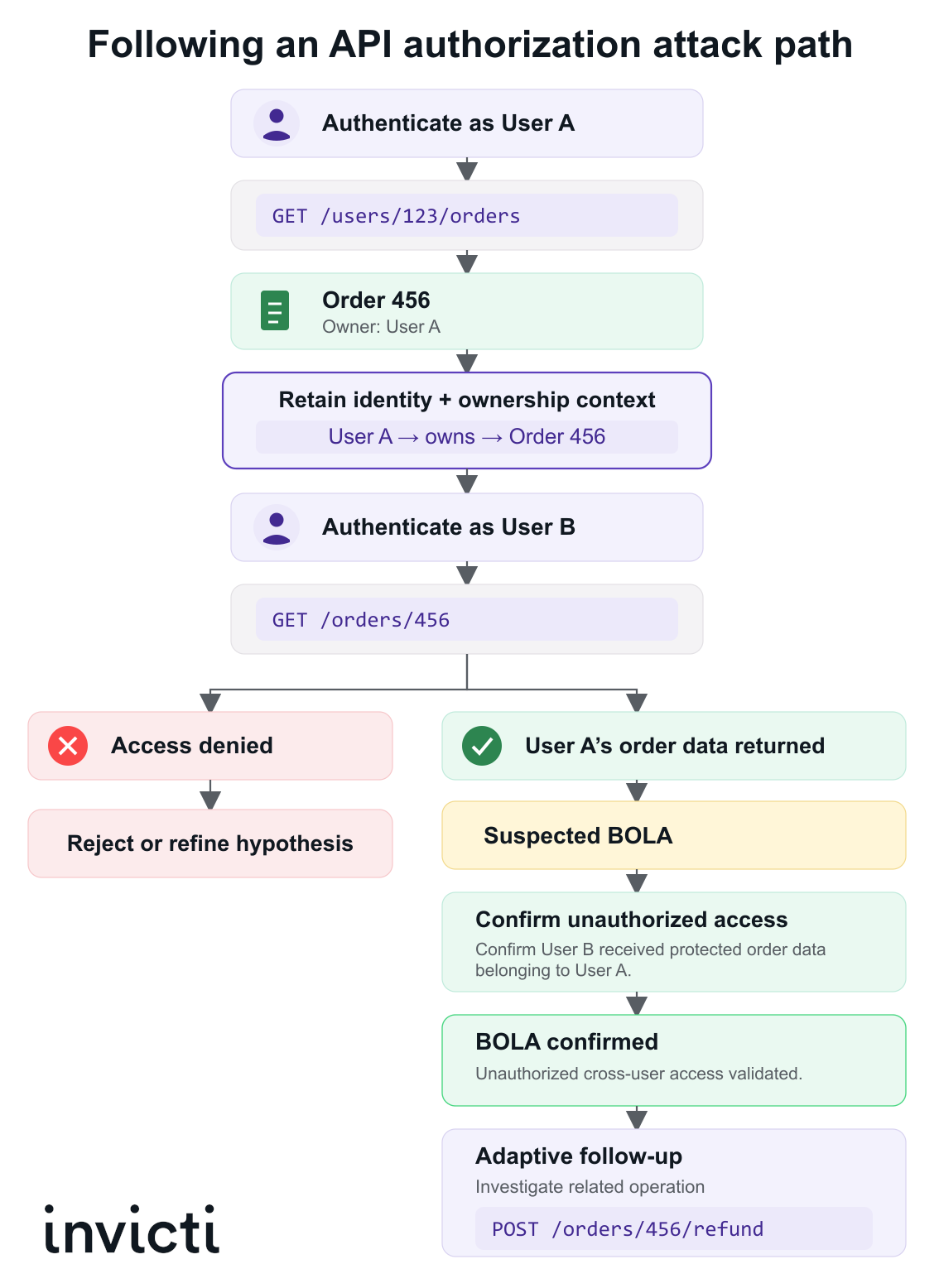
Consider a simplified sequence of requests to an ordering API to get a refund for a specific order:
GET /users/123/orders
GET /orders/456
POST /orders/456/refund
The assessment begins with an authenticated request as User A:
GET /users/123/orders
The response identifies order 456. The agent now has useful context: the object exists and is associated with User A.
Next, the same object is requested using User B’s authenticated session to check whether User B can access User A’s order:
GET /orders/456
If the API correctly denies access, the authorization weakness hypothesis is rejected.
If User B receives User A’s order data, there is evidence of a potential BOLA vulnerability. The result is meaningful because the test preserves the relationship between identity and object ownership. Simply replacing one numeric identifier with another would not establish the same thing.
The successful unauthorized read also creates a new hypothesis. The API exposes a related operation:
POST /orders/456/refund
If object-level authorization is missing when retrieving the order, could the same weakness affect a state-changing operation?
Adaptive testing can carry forward the identity and object context and use the result to investigate the refund operation within the assessment’s safety controls. If the request returns 403 Forbidden, it can evaluate whether another role, workflow state, or related endpoint warrants investigation – or conclude that the authorization control works and stop pursuing that path.
That ability to extend, refine, or reject a hypothesis based on runtime observations is where agentic testing adds value: by making context-informed decisions about which security question to ask next.
Beyond object authorization
The same principle applies to API workflows. Consider a transaction with several permitted states:
Create → approve → pay → cancel → refund
Relevant tests might investigate whether a refund can happen twice, whether an operation can occur before a required predecessor, or whether one user can act on another user’s transaction.
A predefined test suite can cover known patterns, while agentic reasoning can help when an observed state transition or response determines which sequence or operation is worth investigating next.
Some business-logic weaknesses will still depend on knowledge the application cannot provide. Knowing that a transaction above a particular threshold should require additional human approval, for example, may require organization-specific context. Human expertise remains important where recognizing abuse depends on that kind of business knowledge.
Moving from observation to evidence
A typical agentic testing loop might be:
Observe → hypothesize → test → interpret → adapt → validate
There are multiple data sources feeding the process:
- Authentication state can establish the identity, role, or tenant making a request.
- API specifications can reveal routes and data models.
- Source code, when available, can provide implementation context.
- Previous runtime observations can reveal object relationships and application state.
Together, these inputs can help an agent decide what to test next, but they do not establish exploitability by themselves.
This is a crucial boundary. Agentic systems can generate and explore security hypotheses more flexibly than predefined testing, but evidence from the running application should be what determines the threshold for actually reporting a vulnerability.
Why more autonomy makes validation even more important
API responses while testing can be ambiguous. A 200 OK response can actually contain an application-level error. A timing difference can have several explanations. Successfully retrieving an application object does not necessarily mean the access was unauthorized.
AI can interpret those signals and decide that further investigation is warranted. However, AI confidence that something is wrong isn’t yet a vulnerability confirmation.
For an authorization issue such as the order example, a defensible result needs to demonstrate the boundary that was crossed: User B was able to retrieve or manipulate an object that should only have been accessible to User A.
Other vulnerability classes require different evidence, but the principle is the same. The reasoning process can be exploratory, but reported findings must remain grounded in demonstrated runtime behavior.
This also matters for remediation. Developers need more than a statement that an AI system considers an endpoint suspicious. They need evidence showing what was sent, what happened, and why the behavior represents a security problem.
How Invicti combines agentic reasoning with runtime testing
Invicti Agentic Pentesting combines specialized AI agents with Invicti’s established DAST and runtime testing capabilities. AI handles work that benefits from reasoning and adaptation, while established testing techniques handle systematic security checks and runtime validation.
The process starts with reconnaissance. Invicti can use its established crawling capabilities, technology-aware analysis, authentication and session context, and source code when available to build an application-specific picture and attack plan.
During testing, specialized agents can work in parallel and share context. They can generate application-specific security checks, interpret results, refine hypotheses, and use DAST strategically where established runtime testing is the appropriate tool. Spending time and tokens on AI reasoning isn’t always necessary if you have deterministic checks that DAST already performs efficiently.
For APIs, agentic testing works alongside Invicti’s API security capabilities. Multi-layered API discovery can identify APIs using sources including web application scanning, source code, network traffic, and API gateways. This is particularly important for shadow and undocumented APIs: agentic testing cannot assess an API that remains unknown, so discovery and testing need to work together. APIs can then be tested based on specs that have been explicitly provided, discovered, or reconstructed. Stateful API scanning maintains workflow context and infers parameter relationships, while multi-user and multi-role testing supports authorization scenarios such as BOLA and BFLA.
Agentic Pentesting adds adaptive investigation where deeper, application-specific exploration is useful. Candidate findings are grounded in runtime evidence before reporting. Where supported, Invicti’s proof-based scanning can also automatically confirm exploitability for vulnerabilities found through DAST.
Together, these capabilities support Invicti’s broader runtime intelligence approach: security context should come from multiple testing methods, while evidence from the running application is what helps teams focus on real application risk.
Where agentic pentesting fits in an API security program
Not every API or every release needs the same testing depth. API DAST is suited to broad, repeatable runtime testing across large application and API portfolios. Agentic testing can add deeper investigation where risk or application complexity justifies it. Specialist human testing remains valuable when assessments depend heavily on bespoke business knowledge, unusual architectures, threat modeling, or compliance requirements.
Good candidates for deeper agentic assessment can include internet-facing APIs, authentication services, multi-tenant applications, financial workflows, APIs with complex authorization models, and significant releases that introduce sensitive functionality.
Change can also be a useful trigger. A new authentication model, major API revision, newly exposed service, or prior existence of a high-risk vulnerability may justify deeper investigation even when the API already receives regular automated testing.
The goal is to apply additional investigative depth only where it can reveal something that broader systematic testing may not.
What good agentic API testing should deliver
For practitioners evaluating agentic API testing, the important question goes beyond asking if a platform uses autonomous AI. What matters is whether that autonomy produces trustworthy additional security coverage. A useful evaluation can focus on six capabilities:
- Context: Can testing understand authentication, identities, roles, object relationships, workflow state, and relevant application information?
- Adaptation: Can the system change its testing strategy based on what it observes rather than only execute generated variations of predefined tests?
- API coverage: Can it discover and test the API surface, including APIs missing from maintained specifications?
- Controlled autonomy: Can teams define scope, authentication, request rates, and other safeguards around autonomous actions?
- Runtime evidence: Are candidate vulnerabilities validated against the running API with reproducible evidence?
- Operational integration: Can confirmed findings flow into remediation, retesting, and wider AppSec workflows?
These criteria provide a more useful measure of agentic security testing than the presence of AI alone. For enterprise AppSec, autonomy is valuable when it expands what can be investigated without weakening confidence in what gets reported.
Conclusion: Agentic API pentesting should be built around evidence
APIs reward contextual investigation. Identities interact with objects, endpoints form workflows, state changes over time, and one response can determine what an attacker attempts next. Agentic pentesting provides a way to automate more of that adaptive investigation relative to periodic manual testing, but it works best as part of a broader API security architecture.
To get the best out of agentic API testing, organizations still need to discover the API surface and test it systematically at runtime. Where application behavior creates a promising attack path, agentic reasoning can investigate further. And before a suspected issue becomes a vulnerability finding, runtime evidence needs to show that the security impact is real.
The progression is straightforward: find the API, establish its context, test it systematically, investigate adaptively where warranted, and validate the result at runtime.
Invicti brings all those capabilities together through API discovery and security testing, DAST-backed runtime intelligence, and agentic pentesting that uses AI for deeper investigation while keeping reported findings grounded in runtime evidence.
Learn how Invicti Agentic Pentesting works and request a demo to see it in action.
Frequently asked questions
FAQs about agentic pentesting for APIs
Agentic pentesting for APIs uses autonomous AI agents to adapt penetration-testing actions according to API responses, authentication context, application state, and previous observations. An agent can form security hypotheses, generate targeted tests, interpret results, and decide what to investigate next.
Agentic reasoning can help investigate BOLA by preserving user and object context, comparing behavior between authenticated identities, and pursuing related attack paths. A suspected issue still needs runtime validation showing that one identity can access a protected object belonging to another identity.
Agentic testing can investigate API business logic where security depends on workflows, state, roles, or sequences of requests. It cannot guarantee discovery of every business-logic vulnerability, particularly where recognizing abuse requires specialized knowledge of an organization’s rules or intent.
Authentication provides context that can determine which API operations and data should be available to a particular identity. Agentic testing can preserve authenticated sessions and use differences between users, roles, or tenants to guide subsequent tests. This is particularly important when investigating authorization weaknesses where the security outcome depends on who performs an action rather than simply whether an endpoint accepts a request.
No. Agentic testing can automate more adaptive investigation, while human pentesters remain valuable where testing requires specialized business knowledge, bespoke threat modeling, unusual architectures, or human judgment.
No. API DAST provides broad, repeatable runtime testing using established security checks. Agentic pentesting complements that foundation by adapting its investigation based on application-specific context and previous results. The two approaches are complementary: DAST provides systematic coverage and runtime evidence, while agentic reasoning adds investigative depth where additional context is useful.
API vulnerabilities often depend on deployed behavior, including authentication, authorization, application state, and configuration. Runtime validation tests a suspected weakness against the running API to establish whether it produces actual security impact. This helps distinguish a promising hypothesis or suspicious response from a vulnerability that developers can reproduce and remediate.
Experience the future of AppSec
