
How API sprawl creates security blind spots
API sprawl creates security blind spots that make it harder to protect modern applications. As organizations build more APIs across cloud platforms, microservices, SaaS integrations, and AI-driven workflows, many lose visibility into parts of their API attack surface. Undocumented APIs, forgotten endpoints, and unmanaged integrations can persist outside inventories and security programs, creating opportunities for attackers to find weaknesses before defenders know they exist.
Understanding where these blind spots come from is the first step toward reducing API risk. This article examines the visibility failures behind API sprawl, the security risks they create, and why continuous API discovery has become essential for maintaining an accurate view of the modern attack surface.

That connectivity creates business value, but it also poses a visibility challenge. According to the 2025 Imperva API Threat Report, organizations typically have 10% to 20% more active APIs than they realize. At the same time, Salt Security research found that 80% of organizations lack continuous, real-time API monitoring.
This visibility gap is what turns API growth into a security concern. The scale of the problem is often larger than security teams realize. If an organization believes it manages 500 APIs, there may on average actually be 550 to 600 active APIs in the environment. Those additional APIs are not dormant assets waiting to be discovered. They are live endpoints handling requests, processing data, and expanding the organization’s attack surface without necessarily receiving the same level of security scrutiny as documented APIs.
API sprawl occurs when the number of APIs, endpoints, services, versions, and integrations grows faster than an organization’s ability to inventory, monitor, and secure them. The result is a growing disconnect between the APIs security teams believe exist and the APIs that are actually running across production, cloud, partner, and development environments.
What is API sprawl?
API sprawl is the uncontrolled or poorly governed expansion of APIs across an organization’s application environment.
A sprawling API estate can include:
- Public APIs exposed to customers, partners, or third parties
- Internal APIs connecting microservices and business systems
- Legacy APIs that remain active after migration projects
- Shadow APIs created outside formal security processes
- Zombie APIs that were supposed to be retired but remain reachable
- API versions that continue to run indefinitely for backwards compatibility after newer versions are released
- AI and MCP-related integrations that connect agents to tools, data, and workflows
API sprawl is a natural consequence of business and engineering pressure. Development teams are expected to release faster. Cloud-native applications rely on service-to-service communication. SaaS platforms need integrations. Business units adopt tools without always involving central security. Mergers and acquisitions introduce new applications and undocumented dependencies.
Over time, the API environment becomes too dynamic for spreadsheets, manual reviews, and static documentation to track.
Why API sprawl is accelerating
API sprawl has rapidly progressed from a nuisance to a critical governance and security problem because several technology and business trends are all pushing API growth in the same direction.
Microservices and distributed architectures
Modern applications increasingly rely on microservices instead of monolithic architectures. A single application may now depend on dozens or hundreds of services, each communicating through APIs. This improves flexibility and scalability, but it also multiplies the number of endpoints that need to be documented, tested, monitored, and secured.
Faster development and platform engineering
Agile, DevOps, and platform engineering practices help organizations ship software faster. Gartner has predicted that 80% of large software engineering organizations will establish platform engineering teams as internal providers of reusable services, components, and tools for application delivery. That improves developer productivity, but it can also increase the rate at which APIs are created and reused across teams – and when API creation becomes easier, API inventory needs to become more automated to keep up.
SaaS, cloud, and third-party integrations
Most enterprises now depend on a mix of internal applications, public cloud platforms, SaaS tools, partner systems, and third-party services. APIs are what makes those connections possible, but they also create a growing mesh of dependencies that security teams may not fully see or understand unless discovery is continuous.
Mergers and acquisitions
Technology M&A can also accelerate API sprawl. Acquired companies bring their own applications, APIs, environments, documentation standards, and security assumptions. Even when the business integration is successful, the technical integration often leaves security teams with incomplete visibility into inherited APIs and exposed services across growing environments.
AI and agent-driven integrations
AI in its many forms and uses is the newest sprawl accelerant. AI assistants, autonomous agents, retrieval-augmented generation systems, and Model Context Protocol (MCP) servers all rely on APIs to access tools, data, and business systems. MCP is especially important because it gives AI systems a standardized way to connect with external tools and data sources. That standardization can speed adoption, but it also creates a new API governance challenge.
API sprawl is no longer only a human governance problem. AI systems can expand API relationships faster than traditional inventory practices can follow.
How different sources of API sprawl contribute to different security gaps
Understanding the causes of API sprawl is important because each cause tends to produce a different type of security blind spot:
- APIs created through platform engineering initiatives often become shadow APIs when governance cannot keep pace with deployment velocity.
- Deprecated services become zombie APIs when documentation is updated but infrastructure remains active.
- AI-generated APIs can reach production before security review processes catch up.
- Internal microservice APIs create visibility gaps because they rarely appear in traditional inventories.
While these causes appear different on the surface, they all contribute to the same outcome: APIs become harder to discover, understand, and govern. The result is a set of recurring visibility failures that create the security blind spots discussed below.
Continuous API discovery exists to close these visibility gaps by identifying APIs regardless of how they were created or where they operate. The technical and operational challenge is to find all the right APIs using discovery methods best suited to each type of blind spot.
The API visibility gap creates a security problem
Having many APIs is not inherently bad. In fact, a large API ecosystem can be a sign of a mature and scalable digital business. The risk comes when the actual API footprint grows beyond the organization’s visibility and control.
Security teams cannot test APIs they do not know exist. They cannot assign ownership to endpoints they cannot identify. They cannot monitor traffic they do not capture. They cannot prioritize risk across an inventory that is incomplete.
This is why API discovery is increasingly becoming a foundational security capability. Organizations are moving beyond static inventories toward continuous discovery approaches that combine traffic analysis, active testing, specifications, repository signals, and runtime visibility to identify APIs as environments change.
This is the causal chain that turns API sprawl into a security risk:
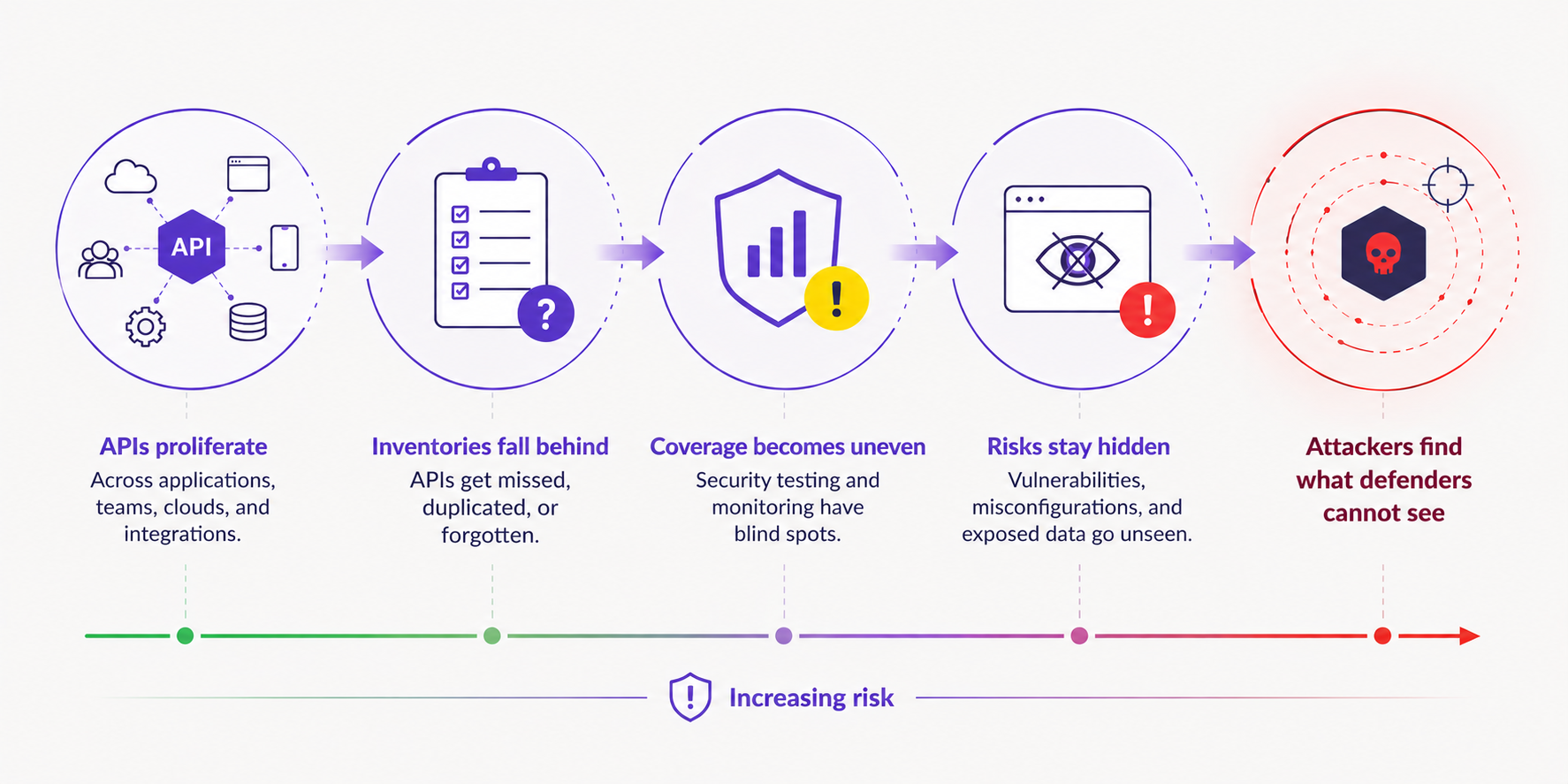
How API sprawl creates security blind spots
API sprawl creates many different security problems, but most of them stem from underlying visibility failures. Each visibility gap makes it harder for security teams to understand their true attack surface, apply the right controls, and validate that APIs remain secure as environments evolve.
Blind spot 1: Unknown APIs
The most obvious consequence of API sprawl is the existence of APIs that security teams do not know about. These unknown APIs can include shadow APIs created outside formal governance processes, staging APIs accidentally exposed to the internet, partner endpoints built for temporary integrations, or services that were deployed without being added to an inventory.
If an API is not known, it is unlikely to be included in vulnerability scanning, penetration testing, compliance reviews, or remediation workflows.
From an attacker’s perspective, undocumented APIs are often attractive because they receive less scrutiny than highly visible production systems. Visibility problems often overlap with access-control problems. According to Wallarm’s 2026 API ThreatStats Report, 59% of API breaches involved endpoints that required no authentication. When organizations lose track of APIs, they also lose confidence that authentication, authorization, and exposure controls are being applied consistently across the environment.
The downstream security impact is measurable. Salt Security’s 2025 research found that 57% of surveyed organizations experienced an API-related data breach in the previous two years, and 73% of those organizations experienced multiple breaches.
The 2022 Optus breach demonstrates how dangerous these visibility gaps can become. Public reporting described an internet-accessible API endpoint associated with a test environment that lacked sufficient protections and exposed customer data. While the incident involved multiple security failures, it illustrates how APIs that fall outside normal governance and visibility processes can create significant risk.
Blind spot 2: Zombie and unmanaged APIs
Not all API risks come from newly created services. Organizations frequently retire applications, replace integrations, and release new API versions without fully removing older endpoints. Over time, these forgotten APIs become zombie APIs – operational services that no longer have clear ownership, active maintenance, or security oversight.
Zombie APIs often accumulate risk because:
- Documentation becomes outdated
- Monitoring is reduced or removed
- Vulnerabilities remain unpatched
- Ownership becomes unclear
- Security testing focuses on replacement systems
Zombie APIs rarely attract attention until something goes wrong. Because they often sit outside normal ownership, maintenance, and testing processes, vulnerabilities can persist for long periods without being discovered or remediated.
Blind spot 3: Internal APIs and invisible traffic
Not every API is internet-facing. Modern applications rely heavily on internal APIs that connect microservices, containers, cloud workloads, and distributed services. Much of this internal traffic (also called east-west traffic) never passes through traditional gateways or perimeter security controls.
As organizations adopt cloud-native architectures, the number of internal APIs often grows faster than the number of public APIs. These APIs also create a visibility challenge because security teams may not know:
- Which internal APIs exist
- Which services communicate with them
- What data they expose
- Whether they are monitored
- Whether they are being tested
For attackers who gain an initial foothold, internal APIs can become ungated pathways for lateral movement and deeper access into critical systems.
Blind spot 4: Drift and hidden behavior
API inventories tend to be incomplete even when they exist. As APIs evolve, teams add parameters, modify responses, change authentication requirements, and introduce new functionality. Documentation and specifications do not always keep pace.
This creates specification drift – a mismatch between the API security teams believe they are protecting and the API that is actually running. The consequences of that drift can include:
- New endpoints that are never tested
- Sensitive data appearing in responses unexpectedly
- Authorization controls that differ from documented behavior
- Business logic vulnerabilities that escape review
- Security scans that no longer reflect reality
This blind spot is particularly dangerous because organizations often believe they have visibility when, in fact, their knowledge about the API has become outdated.
Blind spot 5: AI-driven API growth
AI adoption has introduced new forms of API sprawl. AI coding assistants can generate API endpoints faster than traditional review processes can assess them. At the same time, AI agents increasingly create API relationships with external tools, services, and data sources as part of their normal operation.
The emergence of MCP has accelerated this trend by making it easier for AI systems to connect to external resources. Every MCP connection creates a new API relationship between an AI system and a tool, service, or data source. Those relationships can proliferate quickly and may never appear in traditional inventories.
GitGuardian’s 2026 State of Secrets Sprawl report identified 24,008 unique secrets exposed in MCP-related configuration files, including 2,117 confirmed valid credentials. Each exposed credential potentially represents access to an API or service that security teams may not know exists, illustrating how AI-driven integrations can expand attack surfaces faster than traditional governance processes can track them.
So the challenge is twofold: the growing number of APIs being created plus the speed at which new API relationships appear and evolve. Human governance processes struggle to maintain visibility when integrations can be created, modified, and expanded at machine speed.
Why traditional controls struggle with API sprawl
Akamai’s 2026 API Security Impact Study found that while 80% of organizations use web application firewalls, only 35% use dedicated API security technologies. This gap highlights a common misconception. Many organizations assume traditional security controls provide sufficient API protection, but most of those controls were not designed to solve API visibility challenges.
The issue is not that those traditional controls are useless but that they were not designed to solve the full API visibility problem. A web application firewall, for example, may help block known attack patterns, but it’s not designed or intended to automatically give security teams a complete, continuously updated inventory of every API across production, staging, cloud, legacy, and AI-related environments.
Similarly, API documentation can help developers and testers, but it only reflects what teams have documented. It may not include shadow APIs, zombie APIs, deprecated versions, undocumented endpoints, or runtime-only behavior.
Code repositories provide yet another source of visibility, but they don’t always reflect everything that is actually deployed, internet-accessible, and actively used.
No single source tells the whole story, which is why API discovery needs to be multilayered. Organizations need to combine several approaches, including traffic analysis, specification discovery, active scanning, passive observation, code and repository signals, and application crawling where appropriate.
The goal goes beyond creating a list of APIs – you need to build and maintain an accurate, current view of the real API attack surface.
Closing API blind spots through discovery
API sprawl is ultimately a visibility problem, which is why continuous API discovery has become a foundational security capability.
No single discovery method can uncover every API. Organizations typically need a multilayered discovery strategy that combines runtime observation, traffic analysis, documentation analysis, code-based visibility, and active testing. Each method reveals a different part of the attack surface and addresses a different visibility gap:
Because APIs are constantly being created, modified, deprecated, and replaced, dscovery cannot be a one-time project. An inventory built today may be incomplete or outdated within weeks.
Effective API security therefore requires continuous discovery that feeds into security testing, vulnerability management, ownership workflows, and broader application security posture management.
The result is a continuously updated inventory that helps organizations answer fundamental questions such as:
- Which APIs exist?
- Where are they hosted?
- Are they internet-facing or internal?
- Which teams own them?
- Which applications and data do they support?
- Are they documented?
- Are they actively used?
- Are they being tested?
- Should they still exist?
This is where discovery connects to security outcomes. Once APIs are visible, teams can test them. Once they are tested, teams can prioritize real risk. Once risk is understood, teams can remediate with confidence.
For organizations adopting a DAST-first approach to application security, discovery and validation work together. Discovery identifies the APIs that exist. DAST helps determine which vulnerabilities in those APIs are actually exploitable. Combined with broader platform visibility, this allows teams to focus remediation efforts on the APIs that represent real business risk rather than relying on incomplete inventories or assumptions about exposure.
Moving from API sprawl to API visibility
API sprawl is not going away because modern software already depends on APIs, and AI adoption will only increase that dependency while accelerating deployment velocity. The most secure organizations will not be the ones with the fewest APIs. They will be the ones with the clearest, most current view of their API attack surface.
The visibility failures created by API sprawl all share the same root cause: security teams cannot protect what they cannot see.
This is why API discovery has become a foundational security capability. Visibility is the prerequisite for every other security activity. Before teams can test APIs, prioritize risk, validate vulnerabilities, or remediate exposures, they first need to know what exists.
The challenge is turning discovery into continuous visibility across the entire API estate. Traffic analysis can identify active undocumented endpoints. Repository analysis can reveal APIs earlier in the development lifecycle. Runtime monitoring can expose internal service-to-service APIs. Active testing can uncover APIs through application behavior. Each method provides a different view of the attack surface and helps close a different visibility gap.
This is the approach Invicti takes with multilayered API discovery. Rather than relying on a single source of visibility, the platform combines multiple discovery methods to uncover APIs across the application lifecycle, including:
- Network traffic analysis to identify active undocumented, shadow, and zombie APIs
- Code repository analysis to discover APIs earlier in the development lifecycle
- Runtime and infrastructure visibility to surface internal and service-to-service APIs
- API gateway integrations to inventory formally managed APIs
- DAST-driven discovery to uncover APIs through application behavior and workflows
All these discovery sources are correlated into a unified API inventory, helping security teams build a more complete view of their API estate instead of relying on a single source of truth. Discovered APIs can then be automatically assessed through DAST-based testing, helping teams move beyond inventory management to understand which APIs present real security risk.
Conclusion: Start with what you don’t know you have
The APIs that create the greatest risk are often the ones that never appear in inventories, security reviews, or testing programs. By the time they are discovered through an incident or breach investigation, attackers may have already found them.
Closing API sprawl blind spots starts with continuous discovery. Security teams need visibility across production traffic, code repositories, cloud-native environments, API gateways, and AI-driven integrations to build an accurate picture of their real attack surface.
Invicti’s multilayered API discovery capabilities help organizations uncover undocumented, unmanaged, and forgotten APIs across modern environments. Combined with DAST-based security testing and validation, discovery becomes more than an inventory exercise – it becomes a continuous process for identifying and reducing real API risk.
Next steps
- See how different API discovery methods work
- Learn best practices for integrating API security into CI/CD
- Request a demo to see multilayered API discovery and DAST-first validation in action on the Invicti Platform
Frequently asked questions
Frequently asked questions about API sprawl
API sprawl is the uncontrolled growth of APIs across an organization. It occurs when APIs are created faster than they can be documented, inventoried, governed, and secured. API sprawl is not simply having a large number of APIs – it is the visibility gap that develops when organizations lose track of parts of their API estate.
API sprawl creates security blind spots that make it difficult to identify and manage risk. Common examples include undocumented shadow APIs, zombie APIs that remain active after deprecation, internal APIs with limited monitoring, specification drift between documented and deployed APIs, and AI-driven API relationships that are not reflected in official inventories.
A shadow API is an API that exists outside formal governance and inventory processes. It was never properly documented or registered. A zombie API is an API that was once documented and managed but should have been retired and remains operational. Both create unmanaged attack surface, but they arise from different lifecycle failures.
AI accelerates API sprawl in two ways. AI-assisted development can generate new API endpoints faster than traditional review processes can assess them, while AI agents create new API relationships with external tools, services, and data sources. As these integrations multiply, security teams can lose visibility into the growing API ecosystem.
The first step is continuous API discovery. Organizations need visibility into APIs across production traffic, repositories, cloud-native environments, gateways, and runtime infrastructure. Once APIs are identified, they can be inventoried, tested, monitored, assigned owners, and integrated into broader application security workflows. Continuous discovery combined with security testing helps organizations reduce the blind spots that API sprawl creates.
Finding unknown APIs requires a combination of several discovery methods to cover different visibility gaps. Invicti uses multilayered API discovery that combines traffic analysis, code repository analysis, runtime visibility, API gateway integrations, and DAST-driven discovery to identify undocumented, unmanaged, and forgotten APIs. These findings are correlated into a unified inventory and can be automatically validated through security testing.
Experience the future of AppSec
