
Vulnerability enrichment checklist: How to turn findings into prioritized risk
Vulnerability scanners can identify thousands of issues, but raw findings rarely provide enough context to decide what to fix first. Vulnerability enrichment adds runtime evidence, threat intelligence, application and business context, ownership, and remediation data to security findings, helping teams turn scanner output into prioritized, actionable risk.
Vulnerability enrichment is the process of adding technical, runtime, threat, asset, business, ownership, and remediation context to security findings so they can be prioritized and remediated effectively.
The practical goal is to make findings easier to verify, prioritize, assign, fix, and retest – not merely to collect more metadata. For AppSec teams combining findings from DAST, SAST, SCA, API security testing, container security, and other sources, enrichment provides the connective context needed to move from individual tool outputs to a managed vulnerability lifecycle.
Why vulnerability enrichment matters
Scanner-assigned severity is a useful data point, but it cannot answer every question required for remediation.
Consider two vulnerabilities with the same CVSS score. One affects an internal test application behind several access controls, while the other is reachable through an internet-facing production application that handles sensitive customer data. The technical severity may be identical, but the risk to the organization is not.
A raw finding is also harder to act on when it lacks a clear owner, evidence, application context, or remediation path. Developers who get a security ticket with little more than a scanner result and severity rating may need to repeat much of the security team’s triage before they decide what to do and when.
Effective risk-based vulnerability management therefore needs context beyond technical severity. Depending on the finding, that can include whether vulnerable functionality is reachable, whether exploitation has been observed in the wild, whether the issue can be validated in the running application, what data and business processes are exposed, and who owns the fix.
External vulnerability data is also affected by these limitations. In April 2026, NIST moved the National Vulnerability Database (NVD) to a risk-based enrichment model in response to continued growth in CVE volume. The change reinforces a broader point for security teams: external vulnerability databases are valuable enrichment sources, but application-specific prioritization requires additional signals. NVD data, CNA advisories, CISA’s KEV catalog, EPSS, vendor data, scanner evidence, runtime evidence, and internal application context each answer different questions.
For risk-based prioritization, no single signal provides a complete measure of application risk.
Vulnerability enrichment checklist
A practical vulnerability enrichment framework should answer at least seven questions, discussed in detail in the sections that follow:
- What is the finding?
- Is it present, reachable, and exploitable?
- What does external threat intelligence tell us?
- What application and business context changes the risk?
- Who owns it?
- What needs to happen next?
- Has remediation worked?
The detailed vulnerability enrichment checklist below expands those core questions into specific information that teams can capture or derive. Not every field will apply to every vulnerability or testing method.
A vulnerability is sufficiently enriched when the team has enough reliable information to understand what the issue is, how relevant it is to the application, how much risk it represents, who owns it, and what should happen next.
Let’s look at each enrichment dimension in detail.
What is the finding?
Start by establishing a reliable vulnerability record. Basic data can include the vulnerability class, affected application, URL or API endpoint, source-code location, package or container, first and last seen dates, and the security tool that produced the finding.
Standard identifiers make it easier to connect findings with external sources. CWE describes classes of software weaknesses. CVEs identify publicly disclosed vulnerabilities, while CPE can help identify affected products and platforms. CVSS provides standardized technical severity information.
For CVEs, information from the relevant CVE Numbering Authority (CNA) can add vendor-specific details on the affected version, scoring, and remediation. For open-source components, package advisories and fixed-version information can help identify the appropriate remediation.
This is also where normalization matters. Different tools can describe equivalent vulnerability classes, severities, statuses, and assets differently. Standardizing those fields gives later enrichment and prioritization a consistent foundation.
Is it present, reachable, and exploitable?
Knowing that a vulnerability was identified is very different from knowing how relevant it is to a particular application in terms of risk.
Enrichment in this dimension can include getting answers to questions like:
- Is the vulnerable application or component present at runtime?
- Is vulnerable functionality reachable?
- Is the application internet-facing?
- Is authentication or user interaction required?
- Does a public exploit exist?
- Has exploitation been reproduced or validated?
- Do compensating controls (like a WAF) affect the attack path?
Of those, runtime evidence is particularly valuable for application security because it shows the behavior of the running application.
Dynamic application security testing (DAST) interacts with running applications and APIs to identify vulnerabilities under runtime conditions. With Invicti, proof-based scanning can safely confirm exploitability for supported vulnerability classes and provide evidence that a reported issue is real.
That evidence can improve both prioritization and developer trust. A ticket that includes clear validation evidence gives the receiving developer more to work with than a theoretical finding that needs to be manually reproduced before remediation can begin.
Runtime intelligence can also strengthen findings from other testing approaches. Where technically possible, Invicti’s DAST-to-SAST correlation can connect a runtime vulnerability to the relevant source-code path and ownership context.
Runtime validation should not become an absolute filter. Not every vulnerability can or should be proven through exploitation, and lack of runtime proof does not make a finding irrelevant. Static SCA, for example, can identify a vulnerable dependency that has not been observed dynamically but still requires assessment.
The aim is to use the strongest available evidence for each finding.
What does external threat intelligence tell us?
Runtime evidence tells you about the flaw in your application. External intelligence adds context about the vulnerability more generally and current threat activity.
The major enrichment sources answer different questions:
The sources are complementary. For example, CISA’s KEV catalog identifies vulnerabilities with evidence of exploitation in the wild, EPSS estimates the probability that a published CVE will be exploited in the next 30 days, while CVSS describes the technical severity.
A KEV-listed vulnerability affecting an exposed critical application may deserve rapid escalation. A high EPSS score can also increase urgency when the affected component is present and reachable. But neither signal should be considered in isolation from exposure, exploitability, and business impact.
Good vulnerability risk enrichment combines external intelligence with evidence from the organization’s own applications.
What application and business context changes the risk?
A technically identical vulnerability can have very different consequences depending on where it appears. Relevant context can include whether the application is:
- Production or non-production
- Internet-facing or internal
- Customer-facing or operational
- Business-critical
- Processing sensitive or regulated data
- Within a particular compliance scope
- Protected by compensating controls like a WAF
- Dependent on other critical applications, services, or APIs
This connects technical vulnerability data to organizational impact.
API context is also increasingly important here. API discovery and API security testing can identify attack surfaces that may be incomplete or absent from conventional inventories. This helps teams understand which endpoints and services are actually exposed and where vulnerabilities sit within application behavior.
Context should persist and be updated with the application rather than being rediscovered during every triage cycle. Otherwise, teams will waste time repeatedly answering the same questions about criticality, exposure, data, and ownership.
Who owns it?
A vulnerability cannot become an actionable remediation item until somebody is responsible for it. Ownership enrichment can connect a finding to an application owner, repository, CODEOWNERS entry, development team, service, product, business unit, or security owner.
This information has direct operational value. A critical finding without a known owner can remain unresolved for longer while security teams identify the correct development group or incorrectly assigned tickets are rerouted. A well-enriched finding can be routed directly to the team that can fix it.
Ownership data also needs maintenance. Applications change hands, repositories move, services are retired, and teams reorganize. Mapping ownership at the application and development-system level is more scalable than manually identifying an owner for every new finding.
What needs to happen next?
Ideally, enrichment should directly enable remediation. Once enough context exists to establish priority, the finding should carry all the information required for the next action. That can include remediation guidance, responsible owner, priority, remediation SLA, due date, ticket status, compensating controls, and any approved risk acceptance.
At this stage, ticket quality starts to matter. Sending developers more context does not mean dumping all and any available enrichment data into Jira or another issue tracker. The ticket should contain the evidence and remediation information needed to act: what is vulnerable, where it is, why it matters, how the issue was validated, what needs to change, and when the fix is expected. Where secure coding or remediation training is available, linking the finding to relevant developer guidance can shorten the path from understanding the problem to implementing a fix.
Based on context and available resources, some remediation requests may result in the risk being accepted and the ticket closed or deferred, so risk acceptance also needs to be part of the lifecycle. Accepted risks should have a documented rationale, owner, and expiration or review date rather than disappearing indefinitely from active remediation.
Has remediation worked?
Implementing a fix and closing a ticket is not the same as removing a vulnerability. Wherever possible, remediation workflows should include retesting to verify that the issue is no longer present. Failed verification should reopen or otherwise return the finding to the remediation workflow with appropriate feedback so the initial fix attempt isn’t treated as the end of the process.
This closes the loop of vulnerability management:
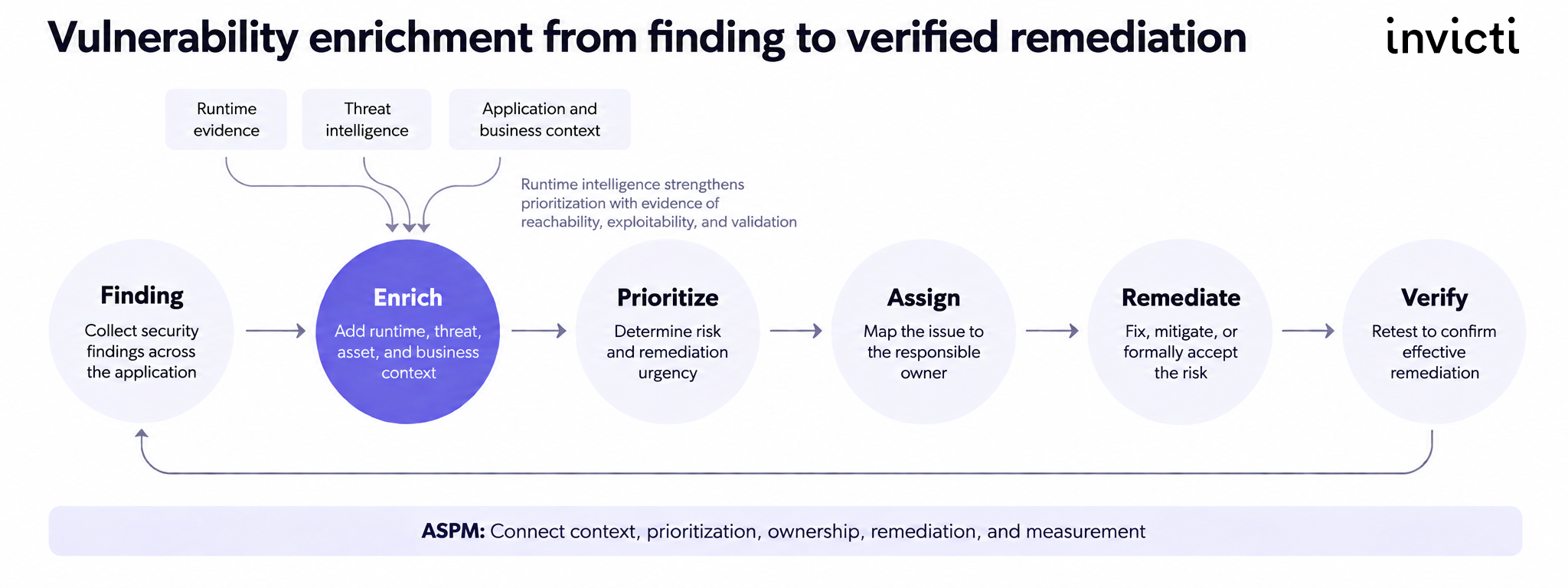
Managing that process as a lifecycle provides a more meaningful view of security posture than changes in raw finding counts.
Enrichment vs deduplication, correlation, and prioritization
These processes are closely related but solve different problems:
Understanding those differences is crucial when aggregating findings from multiple AppSec tools.
Vulnerability deduplication prevents teams from repeatedly triaging the same underlying issue. Correlation can reveal relationships between findings, applications, code, and runtime behavior. Enrichment supplies the additional evidence and organizational context. Prioritization then uses those inputs to decide what should happen first.
An effective security posture management program needs all of these capabilities in the right places – deduplicating an issue does not establish risk, while enriching ten duplicate records does not help with prioritization.
10 steps of vulnerability data enrichment
A repeatable vulnerability enrichment workflow can follow these steps:
- Collect the finding. Capture its source, affected application or component, vulnerability class, evidence, severity, and available identifiers.
- Normalize the data. Standardize fields such as severity, status, CVE, CWE, CPE, application, component, and environment.
- Deduplicate and correlate. Remove redundant records and connect related findings where a defensible technical relationship exists.
- Add runtime and exposure context. Establish whether the affected application, API, code path, or component is present and reachable, using runtime evidence where available.
- Add threat context. Incorporate relevant CVSS, KEV, EPSS, NVD, CNA, vendor, and other threat intelligence.
- Add application and business context. Identify application criticality, sensitive data, exposure, compliance scope, and compensating controls.
- Map ownership. Connect the finding to the responsible application, repository, service, team, product, or business unit.
- Set remediation priority and requirements. Use the enriched context to determine priority, SLA, due date, and any required escalation.
- Route, remediate, and verify. Send the finding into the appropriate DevSecOps remediation workflow with useful evidence and guidance, then retest after remediation.
- Measure outcomes. Track whether enrichment is improving triage, routing, remediation, and verified risk reduction.
At enterprise scale, automation is essential to deal with multiple data sources. Manually looking up threat intelligence, reconciling scanner results, finding application owners, and creating remediation tickets for every issue is not practical when managing extensive application and API portfolios.
Using vulnerability enrichment to support risk-based prioritization
Enrichment provides the inputs for prioritization, but by itself does not make the prioritization decision. Useful inputs for prioritization fall into four areas:
- Technical context, including severity, vulnerability class, affected component, and attack requirements
- Runtime and threat context, including reachability, exploitability, validation evidence, KEV, and EPSS
- Business context, including application criticality, exposure, sensitive data, and compliance impact
- Operational context, including ownership, compensating controls, remediation status, and SLA
How these individual factors are weighted will differ between organizations and applications.
Some conditions may also require policy-based escalation rather than a simple additive vulnerability scoring formula. Known exploitation of an internet-facing vulnerability on a critical application, for example, may justify immediate action purely based on policy, even if other risk indicators are moderate.
The objective is a prioritization process that is consistent and explainable while remaining responsive to changes in applications, deployments, and attacker behavior.
How to measure whether enrichment improves remediation
More enrichment fields do not automatically produce better security outcomes. The goal is for the added context to improve decisions and remediation.
A handful of operational metrics can show whether the process is working:
- Enrichment coverage: How many findings contain the context required by policy?
- Owner coverage: How many findings have a responsible remediation owner?
- Validation coverage: How often is strong technical or runtime evidence available?
- Time to triage: How quickly does a finding become an actionable decision?
- Routing accuracy: How often does remediation reach the correct team without reassignment?
- Remediation and SLA performance: How quickly are prioritized risks fixed, and how often are deadlines met?
- Verification quality: How often do fixes fail retesting or findings need to be reopened?
- Exception governance: Are accepted risks reviewed before their approval expires?
Tracking these metrics can also expose problems with the enrichment process itself. Low owner coverage likely points to an application mapping problem. Long triage times can indicate missing context or excessive manual investigation. Frequent reassignment suggests poor ownership data. And high reopen rates can point to weak remediation guidance or incomplete fixes.
The operational goal is finding a shorter, more reliable path from finding to verified remediation.
How Invicti turns enriched findings into action
Application security programs now generate signals across source code, open-source dependencies, infrastructure definitions, containers, APIs, and running applications. Each testing approach provides a different view of risk. Invicti brings those signals together in an AppSec platform built around runtime intelligence.
Across the platform, security signals from code, dependencies, APIs, containers, and running applications contribute different types of risk context. DAST provides direct evidence from runtime testing, while proof-based scanning can confirm exploitability for supported vulnerability classes. Where technically possible, DAST-to-SAST correlation can connect runtime evidence to vulnerable source-code paths. Static and dynamic SCA provide complementary views of third-party component risk, while API discovery and API security testing help expose and assess API attack surface.
Runtime intelligence adds evidence about what is happening in the application itself. That evidence can strengthen prioritization by adding reachability, exploitability, and validation context rather than relying on scanner severity alone.
Invicti’s application-focused threat intelligence adds further context around reachability, exploitability, business impact, and real-world exploit likelihood, including EPSS.
Application security posture management (ASPM) provides the connective operational layer across those signals, bringing findings and context into a managed vulnerability lifecycle. It consolidates and normalizes findings, reduces duplicate noise, supports risk-based prioritization, maps findings to organizational structures, automates routing, tracks remediation and verification, and measures program performance.
The resulting workflow is broader than any individual testing technology:
Find risk → correlate and enrich it → add runtime and threat context → prioritize it → route it to the right owner → remediate it → verify the fix → measure the outcome
That gives security teams a way to manage vulnerability risk across the application lifecycle while giving developers findings with clearer evidence, ownership, and remediation context.
Explore how the Invicti Application Security Platform combines runtime intelligence with security signals across the application lifecycle to help teams prioritize real risk and move from findings to verified remediation. Request a demo to see effective vulnerability data enrichment in action.
Frequently asked questions
Vulnerability enrichment FAQ
Vulnerability enrichment is the process of adding technical, runtime, threat, asset, business, ownership, and remediation context to raw security findings so teams can prioritize and remediate them effectively.
A vulnerability enrichment checklist should cover vulnerability identity, affected application or component, environment, exposure, reachability, exploitability, validation evidence, CVE/CWE/CPE/CVSS data, KEV status, EPSS, business criticality, data sensitivity, ownership, remediation requirements, SLA, workflow status, risk acceptance, and retest status.
CVSS measures theoretical severity but does not account for exploitability in your environment, active threat campaigns, existing controls, or business impact.
Vulnerability enrichment adds context to a finding. Vulnerability prioritization uses that context to determine what should be fixed first. Enrichment supplies the inputs; prioritization turns those inputs into remediation decisions.
CISA KEV identifies vulnerabilities known to have been exploited in the wild. EPSS estimates the probability that a published CVE will be exploited in the next 30 days. Both provide useful threat context, but they need to be considered alongside application exposure, runtime evidence, business impact, and other risk signals.
Invicti brings together security signals across application security testing and adds runtime intelligence, application-focused threat intelligence, and ASPM capabilities. Depending on the finding and testing source, teams can use runtime validation, reachability and exploitability context, proof-based evidence, correlation, deduplication, business context, ownership, prioritization, remediation workflows, and verification to move from security findings to actionable remediation.
Experience the future of AppSec
