
Human-in-the-loop vs fully autonomous pentesting: Finding the right balance
Agentic pentesting brings a fundamental change to security testing: software can now make more of the decisions that previously required a human penetration tester.
Instead of simply executing predefined security checks, AI agents can explore an application, interpret what they find, form hypotheses, choose what to investigate next, generate tests, and adapt their approach based on the results. This makes deeper and more frequent automated testing possible, but it also raises an important question for security leaders: which testing decisions should software be allowed to make independently?

For enterprise security, the practical answer is bounded autonomy. Give agents enough freedom to investigate applications adaptively, but keep that activity inside enforceable technical and operational boundaries. Human involvement can then focus on governance, higher-risk actions, exceptions, and decisions that genuinely require human context.
The goal is not maximum autonomy everywhere. It is to automate as much security work as can be safely bounded and reliably validated.
What autonomy means in agentic pentesting
Human involvement in agentic pentesting is a spectrum rather than a binary choice. Three terms describe different aspects of the operating model: human-in-the-loop and human-on-the-loop describe where people intervene, while bounded autonomy describes the constraints within which agents are allowed to operate independently.
Human-in-the-loop pentesting
Human-in-the-loop pentesting requires a person to review, approve, or perform selected parts of an AI-driven assessment. An agent might autonomously map an application and identify a promising attack path, for example, but require approval before attempting an action that changes application state or carries greater operational risk. This provides direct oversight, but every mandatory checkpoint also puts human capacity back into the critical path.
Human-on-the-loop pentesting
With human-on-the-loop testing, agents operate independently within predefined boundaries while security professionals monitor their activity and retain the ability to intervene. Unlike a human-in-the-loop workflow, routine actions do not stop and wait for individual approval. Humans supervise rather than participate in every decision.
Bounded autonomous pentesting
With bounded autonomy, routine in-scope testing can proceed without active human supervision, while technical controls determine what the system is permitted to do.
Autonomous does not mean unrestricted. Humans still define the target, policy, permissions, testing limits, credentials, and other rules of engagement. The system is then free to make testing decisions inside those boundaries.
This distinction between autonomy and governance is critical:
- Autonomy describes who makes individual testing decisions.
- Governance determines which decisions are allowed.
Here’s how bounded autonomous pentesting differs from a human-in-the-loop model:
How much autonomy is enough?
Consider two hypothetical AI pentesting platforms. One conducts an entire assessment without human involvement but produces a large set of uncertain findings that security analysts must manually investigate. The other autonomously handles most testing, technically validates candidate vulnerabilities, provides reproducible evidence, and escalates the exceptional cases it cannot resolve.
The first might appear more autonomous during testing, and might also generate more findings – but if those findings are uncertain or require extensive manual verification, autonomous testing can create more human work downstream. Rather than counting individual findings, the better measure is how much trustworthy security testing a system can perform without unnecessary human intervention, including the effort required to validate findings and get actionable results to developers.
That means the appropriate level of autonomy depends on what is being tested and what could happen if an autonomous action goes wrong.
Match autonomy to risk
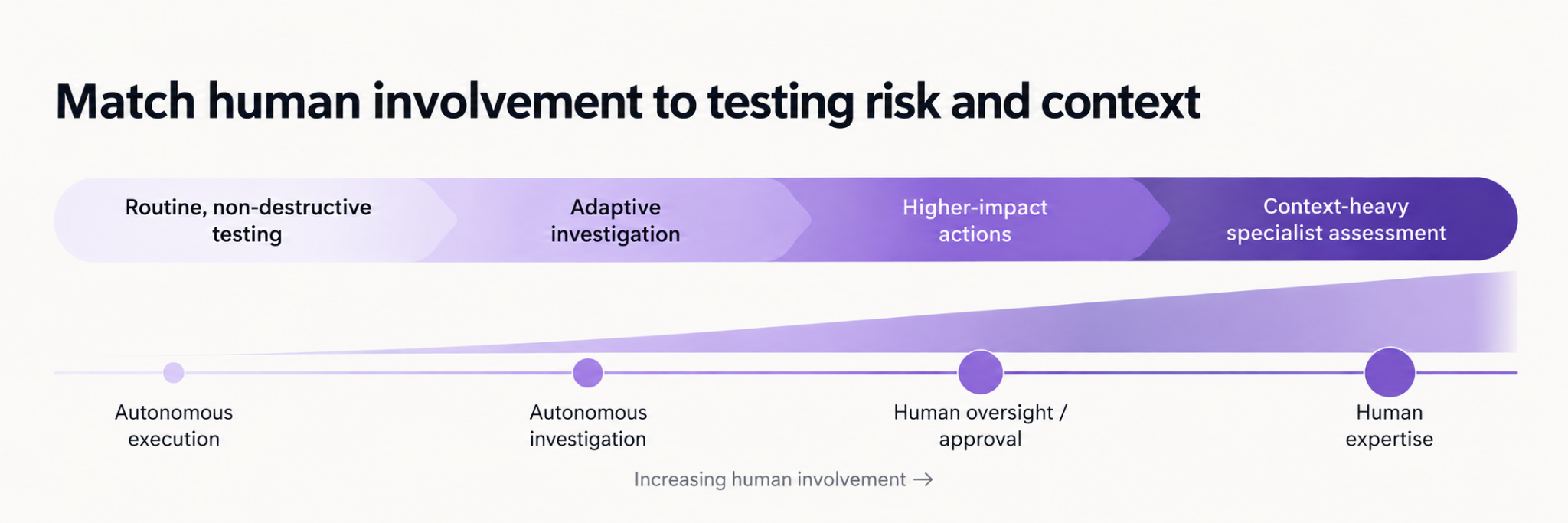
Not every security testing action needs the same level of human involvement. Rather than a binary choice, you can think of it as a spectrum where human input increases with the complexity and potential impact of testing:
Routine, non-destructive testing
Reconnaissance, endpoint exploration, safe request manipulation, established vulnerability checks, and retesting are strong candidates for autonomous execution when appropriate controls are present.
These tasks are frequent, repeatable, and often technically verifiable. Requiring a human to approve every action would provide little additional value while restricting scale.
Adaptive investigation
Agentic systems can go beyond predefined checks by adapting to what they observe. They can explore endpoint relationships, investigate unexpected behavior, generate application-specific tests, and pursue potential attack paths.
This is where autonomy can add significant depth, provided the agent remains inside well-defined scope and testing constraints.
Higher-impact actions
Actions that change application state, affect sensitive workflows, or carry greater operational consequences need stronger controls. Executing operations that could delete production data, modify privileged accounts, transfer money, establish persistence, generate disruptive loads, or interact with safety-critical processes is very different from sending a non-destructive test request.
Depending on the target and action, the appropriate choice might be stricter technical restrictions, active monitoring, explicit approval, use of a non-production environment, or human-led testing.
Context-heavy specialist assessment
Some security questions depend heavily on information outside the application.
Understanding whether an unusual workflow can be abused, for example, may require knowledge of the business process it implements. Bespoke threat scenarios, ambiguous authorization models, and specialized industry risks can similarly benefit from human expertise.
More broadly, there is no one-size-fits-all autonomy level for an entire organization. The challenge is to decide where autonomy makes sense based on target criticality, potential impact, ability to validate the result, and the amount of business context required.
Bounded autonomy needs guardrails and validation
Giving software greater freedom to make testing decisions raises two separate trust questions:
- Can we trust the system to stay within its authority?
- Can we trust the vulnerabilities it reports?
Setting up guardrails addresses the first, while validation addresses the second. Both become more important as autonomy increases.
Guardrails constrain what agents can do
Enterprise autonomous pentesting needs enforceable rules of engagement.
Telling an agent not to go outside an approved domain is an instruction. Technically preventing the testing system from sending requests outside that domain is an enforceable security control.
Important boundaries should therefore be enforced outside the agent wherever practical. Depending on the platform and environment, controls can include target and domain restrictions, authentication boundaries, rate and concurrency limits, restrictions on testing behavior, execution limits, audit logging, role-based permissions, and mechanisms to stop testing.
This is the principle behind bounded autonomy: give agents latitude to decide how to investigate an application without giving them unrestricted authority over the actions they perform.
Validation determines what you can trust
Agentic reasoning creates another challenge. Unlike conventional automation that primarily executes predefined testing logic, an agent can observe application behavior, form a hypothesis, choose how to investigate it, evaluate the response, and adapt its next action.
That flexibility is useful precisely because security testing involves exploring uncertainty – but it also means a plausible hypothesis can turn out to be wrong. A mature agentic testing workflow therefore needs to clearly distinguish between a hypothesis, a candidate finding, and a confirmed vulnerability.
As Invicti has argued in its guidance on agentic offensive security, a confirmed vulnerability should be one that survives validation against the running application. AI confidence alone is not evidence that exploitation succeeded.
Without validation, increased autonomy creates an important scaling issue. If agents can generate security hypotheses faster than humans can verify them, requiring people to reproduce every candidate vulnerability simply moves the bottleneck from testing to triage.
Wherever technical confirmation is possible, runtime validation offers a more scalable approach: test the suspected vulnerability against the running application and look for evidence that the issue is exploitable. Autonomous exploration becomes far more operationally useful when reliable technical validation can scale with it.
Where humans still belong
Greater autonomy changes the point where human expertise is most valuable, but it doesn’t make that expertise irrelevant.
Business context and ambiguous logic
Technical validation can answer whether a vulnerability is present. It cannot necessarily determine what every application behavior means to the business.
An application may technically permit an action, for example, but deciding whether or not that permitted behavior represents meaningful abuse can require knowledge of how the business process is supposed to work. The same applies to unusual authorization models, complex workflows, and ambiguous attack chains where impact depends on context the testing system does not have.
High-risk and specialist testing
Fragile applications, bespoke threat scenarios, highly sensitive systems, and testing actions with potentially serious consequences may justify direct human involvement in the testing process. The appropriate role can range from monitoring or approval to a fully human-led assessment.
Independent assurance
Human expertise can also be part of the assurance requirement itself. A contract, customer, auditor, or regulatory requirement may call for a particular assessment methodology, assessor qualification, or human-led engagement. Organizations should evaluate those requirements directly rather than assuming an autonomous assessment satisfies them.
Human involvement in pentesting should therefore be applied according to risk and context, not inserted into every testing step by default.
How Invicti approaches bounded autonomy
Invicti Agentic Pentest combines adaptive AI agents with Invicti’s established dynamic application security testing (DAST) as the runtime testing foundation for agentic exploration.
The underlying approach assigns different security tasks to the mechanism best suited to them rather than asking AI agents to do every part of the assessment.
Let agents investigate
During reconnaissance, Invicti combines established crawling capabilities with application technology information, authentication and session context, and optional source-code context to build a more informed picture of the target.
An orchestrator develops an application-specific attack plan and coordinates specialist agents. Those agents can investigate different attack possibilities in parallel, share context, generate tests, and adapt their approach based on application behavior.
This is where agentic reasoning adds value: exploring possibilities and making context-dependent testing decisions that cannot all be specified in advance.
Use established testing where it already works
Not every security test needs AI. Invicti DAST already provides systematic runtime testing for established vulnerability classes, along with mature crawling, authentication, application interaction, and repeatable security checks.
Invicti’s approach uses agentic techniques where adaptive reasoning adds value while retaining established runtime testing where deterministic security checks can do the job efficiently. Practical agentic pentesting should extend proven security testing capabilities rather than replace them merely because AI is available.
Validate before reporting
The distinction between exploration and confirmation is central to the Invicti approach.
Agents can form hypotheses and investigate candidate vulnerabilities, but a suspected issue does not become a confirmed vulnerability simply because an AI agent believes it has found something. Invicti separates agentic discovery from deterministic validation against the running application.
For supported vulnerabilities found through DAST, proof-based scanning can automatically confirm exploitability and provide evidence. Candidate agentic findings that cannot be confirmed are marked as inconclusive and surfaced for human review rather than automatically promoted to confirmed vulnerabilities.
That distinction addresses a central scalability problem: security teams and developers can work from validated evidence rather than having to start by manually reproducing every reported vulnerability.
Keep autonomy inside technical boundaries
Invicti also places technical boundaries around autonomous execution.
Agentic Pentest operates against a defined target. Current safeguards include network-level scope enforcement, rate limiting, execution time limits, role-based controls, isolated environments, and non-destructive payload design. Agents orchestrate Invicti’s testing engine rather than receiving unrestricted access to arbitrary offensive tools. These controls give agents room to investigate adaptively while keeping the autonomy bounded.
The resulting division of labor is straightforward:
- DAST and runtime testing: systematic testing, repeatability, mature application interaction, and technical validation.
- Agentic AI: adaptive exploration, contextual reasoning, application-specific testing, and attack-path investigation.
- Humans: governance, business context, specialist judgment, and handling exceptional or ambiguous situations.
The Invicti approach is to automate where testing can be safely bounded and reliably validated, while keeping humans involved where context and judgment add unique value.
The goal is maximum useful autonomy
As agentic pentesting tools become more capable, ‘How autonomous is it?’ becomes an obvious question when comparing them. But for security leaders, a better question is how much testing can be delegated without sacrificing control or confidence in the results.
Routine, non-destructive, technically verifiable work is well suited to greater autonomy. Higher-impact or ambiguous actions can justify monitoring or explicit approval. Highly contextual work should remain human-led.
Bounded autonomy provides the operating principle: automate as much security work as can be safely constrained and reliably validated, while applying human expertise where judgment adds unique value.
For Invicti, that means combining DAST where systematic runtime testing and validation matter, agentic AI where adaptive reasoning adds depth, and human expertise where security decisions depend on context that software alone cannot reliably provide.
Done well, autonomous pentesting can increase the depth and frequency of application security testing without increasing human effort at the same rate. The measure of progress is not how completely humans disappear from the process, but how effectively their expertise is reserved for the work that genuinely requires human judgment.
Next steps
- Learn what separates genuinely agentic security testing from conventional automation in Agentic pentesting tools explained.
- Explore Invicti Agentic Pentest to see how adaptive AI agents work with DAST and runtime validation inside defined testing boundaries.
- Request a demo to evaluate how Invicti Agentic Pentest could fit your application security program.
Frequently asked questions
Frequently asked questions about human-in-the-loop pentesting
Human-in-the-loop pentesting requires a person to approve or perform selected actions before testing proceeds. Human-on-the-loop pentesting allows agents to act independently within defined boundaries while people monitor the assessment and retain the ability to intervene.
Both can form part of a risk-based approach, with the level of human involvement determined by the potential impact of the testing and the amount of contextual judgment required.
Not necessarily. Conventional automated security testing primarily follows predefined testing logic. Agentic pentesting adds autonomous decision-making: software can interpret application behavior, decide what to investigate, generate or modify tests, evaluate results, and adapt its next actions.
The two approaches can complement each other. Established automation is often the most efficient way to perform repeatable security checks, while agentic techniques can add adaptive exploration where predefined logic alone is insufficient.
Autonomous pentesting can automate a growing share of application testing that previously required human effort, especially when assessments need to be performed frequently or across large application portfolios.
Human pentesters remain valuable for specialized research, unusual business logic, bespoke threat scenarios, independent expert assessment, ambiguous security impact, and engagements where human-led testing is explicitly required.
The more useful question is therefore which testing activities still benefit materially from human expertise rather than whether autonomous pentesting can replace manual testing wholesale.
Agentic pentesting in production can be appropriate when the platform and organization have controls suited to the application and intended testing.
Relevant safeguards can include enforceable scope, non-destructive payloads, rate limits, execution limits, role-based permissions, appropriate test identities, monitoring, testing windows, sensitive-workflow restrictions, and recovery procedures. Higher-risk applications or testing actions may warrant additional oversight or a non-production environment.
Invicti separates agentic exploration from validation. AI agents can form hypotheses and investigate potential vulnerabilities, but candidate findings are validated against the running application before being reported as confirmed vulnerabilities.
Invicti Agentic Pentest builds on the company’s DAST and runtime testing foundation. For supported vulnerabilities found through DAST, proof-based scanning can automatically confirm exploitability. Agentic findings that cannot be confirmed are marked as inconclusive for human review rather than being treated automatically as confirmed vulnerabilities.
Experience the future of AppSec
