
How application security supports the DoW Zero Trust Strategy
The US Department of War (DoW) has set the end of fiscal 2027 as the target for implementing target-level zero trust across its information technology systems on unclassified and secret networks. Among the strategy’s seven pillars, Applications and Workloads defines five capabilities covering application inventory, secure software development, software risk management, resource authorization, and continuous monitoring – all areas where application security has a direct supporting role.

Across its seven pillars, the strategy defines 91 target-level capability outcomes and a further 61 advanced-level outcomes. For application security teams, the Applications and Workloads pillar is especially important because identity, device, and network controls alone cannot provide everything it requires. While they do provide some security, they cannot determine whether an application contains an exploitable vulnerability, whether an undocumented application programming interface (API) has eluded inventory, or whether a known vulnerability in a software component creates meaningful risk in a deployed system. Answering those questions requires evidence about the applications and APIs an organization develops and operates.
Historically, much of the early investment and implementation effort around zero trust has focused on foundational identity, access, device, and network capabilities. As those controls have advanced, the applications and workloads pillar has become a more prominent part of the implementation challenge – and one that cannot be addressed through identity and network controls alone. Meeting its outcomes requires dedicated capabilities for discovering, testing, verifying, and continuously monitoring the applications and APIs that teams develop and operate.
This is where application security has a specific role in supporting the DoW zero trust program.
Why applications and workloads need their own zero trust focus
Zero trust programs are often associated most closely with identity and network security. That emphasis makes sense: controlling who can access a resource, from which device, and under what conditions is fundamental to zero trust architecture. The DoW model starts but does not stop there.
Identity and network controls cannot assess application behavior
As zero trust reduces reliance on network location as a proxy for trust, applications and services need to withstand access that is controlled by policy rather than simply being shielded behind a trusted network boundary.
Even when the identity and access decision is correct, the application itself may not be secure. There are many ways this can happen:
- A correctly authenticated and authorized user can submit input that exploits a vulnerability in application functionality.
- A legitimate API request can expose an application-layer authorization flaw, allowing access to data or functions beyond what the requester should be permitted to use.
- An undocumented or unknown API endpoint can fall outside the organization’s inventory, leaving policy enforcement and security testing with an incomplete view of the application attack surface.
That is why the DoW Applications and Workloads pillar explicitly covers application inventory, secure software development and integration, software risk management, resource authorization and integration, and continuous monitoring and ongoing authorizations.
For AppSec teams, the practical requirement is to provide current, defensible evidence about the security of the software actually running.
Application security is integral to both DoW and CISA zero trust
Federal zero trust guidance includes related but distinct models from the DoW and the Cybersecurity and Infrastructure Security Agency (CISA). Their structures differ:
- The CISA Zero Trust Maturity Model uses five pillars: identity, devices, networks, applications and workloads, and data.
- The DoW model uses seven pillars: user, device, applications and workloads, data, network and environment, automation and orchestration, and visibility and analytics.
For DoW organizations, systems, and environments subject to the DoW Zero Trust Strategy, its capability outcomes provide the applicable framework.
The application security direction is consistent regardless of model. CISA’s optimal-stage model calls for application security testing throughout development and deployment, regular automated testing of deployed applications, and continuous monitoring. The DoW model translates similar expectations into specific capabilities and activities for defense organizations:
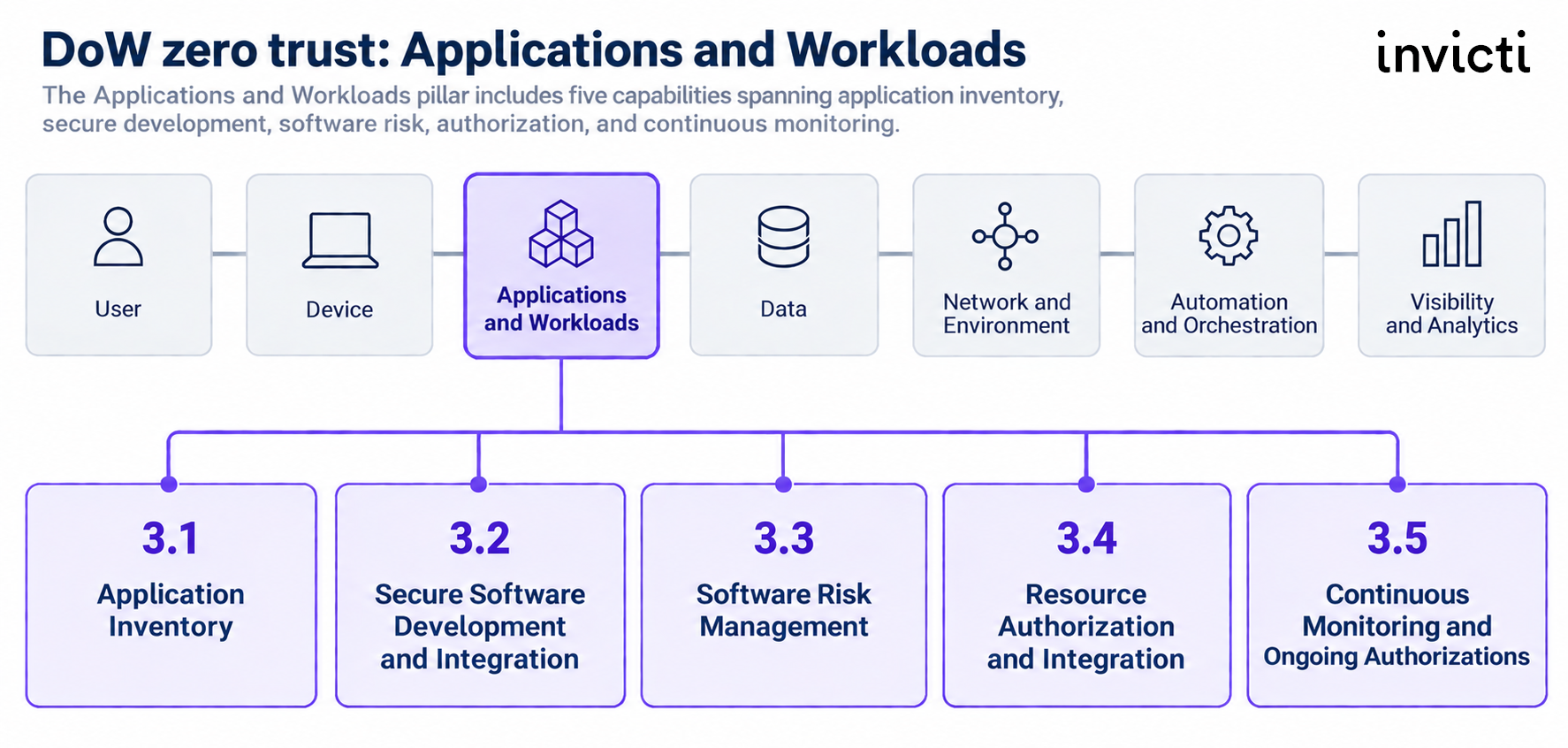
Here’s how the five capabilities that make up the Applications and Workloads pillar in the DoW model map to specific AppSec controls and processes – and how Invicti can support them.
Capability 3.1 Application inventory: Discover what you actually operate
DoW requirement: System owners identify and inventory applications and application components and ensure that only authorized resources are used within their purview.
Invicti relevance: Attack surface management and API discovery can complement administrative inventories by identifying applications, endpoints, and APIs that are actually exposed.
Administrative inventory only shows what you already know about
An inventory assembled from configuration management records, architecture diagrams, and what development teams already know about can miss forgotten applications, untracked endpoints, and shadow APIs.
Invicti’s attack surface management capabilities provide visibility into exposed applications and endpoints. Multi-layered API discovery can identify known and unknown APIs, including endpoints that may not appear in existing specifications or architecture documentation.
For zero trust, systematic discovery is foundational. You cannot consistently secure, test, or authorize a resource if you don’t know it exists.
Capability 3.2 Secure software development and integration: Test throughout delivery
DoW requirement: Capability 3.2 explicitly calls for development teams to use DevSecOps to integrate static and dynamic application security testing into software delivery workflows, alongside code review and security controls for APIs and modern application environments.
Invicti relevance: Invicti combines pre-runtime testing of source code, open-source dependencies, and development artifacts with dynamic application security testing (DAST) to test applications and APIs once they are running.
Cover code, components, and running applications
Static application security testing (SAST) can identify potential weaknesses in source code during development. Software composition analysis (SCA), secrets detection, infrastructure-as-code scanning, container security, and related checks extend coverage across the software and infrastructure being assembled.
DAST provides a complementary perspective. Rather than analyzing code or components in isolation, DAST interacts with a full running application to identify vulnerabilities that manifest in runtime behavior.
Integrating these approaches into continuous integration and continuous delivery (CI/CD) workflows makes security testing repeatable throughout software delivery rather than reserving it for a review shortly before deployment.
Add runtime evidence to pre-runtime findings
The DAST-backed runtime intelligence in the Invicti platform also provides context for findings originating earlier in development.
This matters because identifying a potential weakness and establishing its significance in a deployed application are different tasks. Runtime evidence can help teams understand which issues are reachable or exploitable in the running application and prioritize remediation accordingly.
For organizations with established security toolchains, the objective shouldn’t necessarily be to replace every existing scanner but rather to bring findings together and add the context needed to turn scanner outputs into actionable application risk intelligence.
Capability 3.3 Software risk management: Turn software inventories into risk intelligence
DoW requirement: Capability 3.3 covers supplier sourcing risk, approved repositories, software bills of materials (SBOMs), vulnerability management using industry-standard and Defense Industrial Base (DIB)-specific vulnerability information, and continued validation within software delivery.
Invicti relevance: SCA and SBOM capabilities provide software supply-chain visibility, while application security posture management (ASPM) correlates findings from multiple security disciplines for prioritization and governance.
An SBOM identifies software – but risk decisions still need context
An SBOM can tell you what software is present. Vulnerability intelligence can identify components associated with known vulnerabilities. Neither automatically establishes which issues pose the greatest risk to a deployed application.
Invicti SCA provides visibility into open-source components, known vulnerabilities, and license risk, with SBOM generation and analysis supporting software inventory and supply chain security. Invicti can also extend this visibility to AI-specific dependencies. AI-BOM identifies components such as AI frameworks, model providers, agentic libraries, vector databases, and MCP SDKs through the existing SBOM pipeline, helping teams maintain a more complete inventory as AI components enter the software supply chain.
Runtime context adds the validation and risk intelligence layer by connecting software weaknesses to reachable or exploitable application behavior.
ASPM connects findings across the toolchain
Vulnerability and posture management is particularly relevant in DoW environments that already have years of security tooling in place.
Invicti ASPM provides a consolidated layer for normalizing, correlating, and prioritizing findings from DAST, SAST, SCA, API security, and other security sources. Instead of treating each scanner as a separate queue, teams can work from a more unified view of application risk.
That supports a broader challenge in DoW zero trust implementation: integration. Adding another source of alerts has limited value if security teams cannot determine which findings matter, route them to the right owners, and track remediation.
Capability 3.3 also addresses software supply-chain risk and information associated with the Defense Industrial Base (DIB), reinforcing the need for visibility into the software and third-party components entering DoW environments.
Capability 3.4 Resource authorization and integration: You can’t authorize an API you can’t see
DoW requirement: Capability 3.4 covers standardized authorization gateways integrated with identity and device posture, API micro-segmentation using authorization, and enriched attributes from across zero trust pillars to support authorization decisions.
Invicti relevance: API discovery and testing help establish what APIs exist and where application-layer vulnerabilities occur, while runtime intelligence can add reachability, exploitability, and application context to risk decisions.
Enforcing zero trust for APIs requires comprehensive API visibility
APIs are not peripheral to zero trust architecture but central to it. Applications, services, identity systems, policy components, and authorization gateways all rely on machine-to-machine interfaces. Enforcing zero trust principles consistently across APIs requires visibility into the endpoints to which authorization policies and other controls need to apply.
API inventory and authorization need to describe the same environment. A gateway can only enforce policy on an API it knows about. Even if the policy is perfect, there’s no way to enforce it on an undocumented or shadow endpoint that falls outside the inventory.
Organizations cannot consistently apply per-request authorization to API endpoints that have never been inventoried.
Invicti API Security combines API discovery with API security testing across REST, SOAP, and GraphQL APIs. This allows teams to fill gaps in static inventories, maintain an up-to-date view of their API estate, and identify application-layer vulnerabilities across their known and discovered API attack surface.
Runtime intelligence adds context to authorization-related risks
DoW capability 3.4 also calls for attributes from other pillar activities to enrich authorization decisions.
The Invicti platform is not an authorization or policy enforcement system. Its relevant contribution is application risk context: information about reachability, exploitability, and runtime behavior that can help security teams understand the resources behind those authorization decisions.
Discovery, authorization, and security testing all need to work from an accurate picture of the API attack surface.
Capability 3.5 Continuous monitoring and ongoing authorizations: Keep the evidence current
DoW requirement: Capability 3.5 calls for automated tools and processes to continuously monitor applications and assess their authorization to operate, feeding continuous authorization to operate (cATO) processes.
Invicti relevance: Automated DAST and attack surface management provide repeatable assessment of deployed applications, while ASPM, reporting, and remediation metrics can contribute to the evidence trail used in governance and authorization processes.
Point-in-time assessments age quickly
Applications change continuously. Dependencies are updated, APIs are added, configurations alter exposure, and development teams release new functionality. Evidence collected for an authorization review becomes less representative of the deployed system as the system changes.
DAST is well placed to address this part of the problem because it tests running applications and APIs, not static code or specs. Automated scans can be run in the pipeline and later against deployed systems without depending on source code access or a particular implementation technology. Attack surface management provides additional visibility into changes in what is exposed.
Continuous monitoring needs usable evidence
Running tests continuously is not the same as making their output useful to an authorizing official.
Invicti ASPM can consolidate findings, remediation status, policy information, and metrics such as time to triage and time to fix. Historical information can help teams demonstrate how application risk and remediation change over time rather than presenting another isolated scan result.
Invicti can support continuous monitoring and authorization processes by contributing fresher and more structured application security evidence.
From compliance artifacts to verified security evidence
One practitioner objection to zero trust programs in general is that framework activities can turn into compliance exercises that check the required governance boxes without necessarily improving security. For application security specifically, getting measurable rather than performative results is often a matter of distinguishing between evidence of security activities and evidence of actual security posture.
A scanner report only proves that a scan ran
A raw scanner report can show that testing took place and satisfy a control that requires this type of testing. But without evidence, it does not necessarily establish which findings are real, which are exploitable, which matter most, or which have been remediated.
Invicti’s proof-based scanning addresses part of that problem by safely confirming many types of exploitable vulnerabilities and, where technically possible, providing proof of exploit or proof of concept. Confirmed findings can then move to remediation without requiring a security engineer or developer to manually reproduce each issue.
Automatic confirmations generated by Invicti are reported as more than 99.98% accurate. For a security team, the practical value of this verification is to immediately turn confirmed scanner findings into actionable security evidence. This reduces the manual work needed to separate confirmed vulnerabilities from potential issues while also providing a strong prioritization signal.
Evidence should also be measurable
Application security programs can provide concrete operational measures even when the effectiveness of zero trust as a whole cannot be reduced to a single clear number.
Time to triage, time to fix, service level agreement compliance, vulnerability trends, and remediation status can all help show whether application risk is being managed rather than simply reported.
That makes continuous AppSec evidence useful both to engineering teams fixing vulnerabilities and to the governance processes monitoring security posture over time.
Already have scanners? Focus on integration and evidence
Organizations that are subject to DoW zero trust requirements usually have no shortage of existing security tools. Findings may already be coming from source code analysis, open-source component scanning, DAST, API testing, container scanning, penetration testing, and other scanners. The practical constraint is often the capacity to integrate, investigate, prioritize, and remediate everything those tools produce.
Funding alone does not solve integration
DoW zero trust modernization has received substantial investment, yet reported implementation friction continues to include fragmented governance and integration across components.
Funding a capability does not necessarily resolve the integration work required to make it operational. Additional investment can provide capabilities and resources, but it does not automatically connect security data, normalize findings across tools, or produce the evidence needed for consistent risk decisions.
In the case of AppSec, this again shifts the question from scanner availability and coverage to whether existing security signals can be turned into a coherent view of application risk.
More findings do not automatically mean better risk management
Practical security outcomes depend on turning findings into actionable priorities. That means verifying issues, reducing duplication and noise, correlating risks across tools, and identifying what requires attention first. This is where the broader context added by the Invicti platform becomes especially relevant.
Invicti ASPM can normalize and correlate findings across security tools, while DAST-backed runtime intelligence provides evidence about deployed application behavior. Security teams can use that context to prioritize remediation rather than treating every scanner alert as equivalent.
For organizations already dealing with accumulated tooling and integration debt, that is a very different proposition from adding yet another scanner. The ultimate goal is to turn existing security signals into a prioritized view of application risk that can be used by developers, security teams, program owners, and authorizing officials.
How Invicti maps to the five DoW capabilities
The five capabilities within the Applications and Workloads pillar map to practical application security questions and Invicti platform capabilities as follows:
Note that tool capabilities address testing and evidence needs within the DoW outcomes, but they do not themselves establish target-level or advanced-level zero trust. The responsible DoW authorities determine whether an entity has achieved the required capability outcomes.
Make application security evidence part of the zero trust program
The Applications and Workloads pillar makes an important point explicitly:
Zero trust does not stop at authentication, endpoint posture, and network policy.
Organizations need to know what applications and APIs they operate, integrate security testing into software delivery, understand software supply chain risk, secure API interactions, and maintain current evidence about deployed systems.
The objective is evidence you can act on
For AppSec teams, this changes the role of security testing. The desired output is not another completed scan or compliance artifact but rather defensible evidence about what is running, what is vulnerable, which vulnerabilities have been demonstrated as exploitable, what should be fixed first, and whether the risk picture is improving.
Invicti brings that evidence together across application and API discovery, SAST, SCA, DAST, API security, runtime intelligence, and ASPM – with its deep DAST expertise providing validation against running applications.
See how those capabilities map to your application security program. Book an Invicti consultation for a walkthrough of the Applications and Workloads outcomes most relevant to your environment – including where your existing tools already provide coverage and where better discovery, testing, correlation, or runtime evidence could help close gaps.
Frequently asked questions
Frequently asked questions about application security and DoW zero trust
CISA organizes zero trust around five pillars with several cross-cutting capabilities, while the DoW strategy defines seven pillars and specific target- and advanced-level capability outcomes. For organizations and systems subject to the DoW Zero Trust Strategy, the DoW model provides the applicable framework. Both models recognize application security testing and continuous monitoring as important to zero trust maturity.
No. The DoW Zero Trust Strategy and CMMC are related but distinct. The DoW fiscal 2027 target-level goal applies to the Department and systems and environments within its scope, while Defense Industrial Base (DIB) contractors primarily encounter cybersecurity requirements through their contracts, including CMMC and NIST SP 800-171. CMMC compliance does not establish achievement of DoW target-level zero trust outcomes.
Yes. Automated application discovery, testing, and risk management can provide current security evidence to support continuous monitoring and authorization processes. Invicti can contribute evidence about exposed assets, vulnerabilities, exploitability, remediation, and security trends, but application security tools do not grant a continuous authorization to operate (cATO). Authorization remains the responsibility of the appropriate DoW authorities.
Experience the future of AppSec
