
Why attack chain intelligence changes what you should demand from AppSec tools
Most security tools are optimized to find individual vulnerabilities – and they do that well. But attackers chain multiple flaws together into attack paths that no single finding can reveal. Closing that gap with automated testing requires coordinated reasoning that’s built on top of proven security testing and grounded in runtime evidence rather than inference.
This article explains what attack chain intelligence actually demands, where pure-AI pentesting tools fall short, and what to ask vendors whose agentic claims you're evaluating.
Key takeaways
- Attackers exploit chains of weaknesses, not individual vulnerabilities – but most security tools still surface findings as isolated issues.
- AI pentesting agents add reasoning and chaining capability, but without runtime grounding, they produce unverified attack hypotheses that create additional work or false confidence rather than actionable findings.
- Useful attack chain intelligence requires agents that share state and build on each other’s work throughout an assessment, not just at the end.
- The critical evaluation question isn’t whether a security tool uses agentic AI, but whether it can confirm exploitability at runtime before reporting a finding.
- Agentic penetration testing and DAST are complementary: DAST provides scale, agentic testing provides depth where chained risks matter most.
- Invicti’s Octo agentic pentesting component pairs coordinated AI agents with proof-based DAST, so both chained and individual findings are based on confirmed evidence, not an LLM’s best guess.
Security teams running mature programs often have more findings than they can act on. What they rarely have is a clear picture of how those findings relate to each other: which weaknesses connect, which sequences are exploitable, and which combinations represent real risk versus theoretical noise. That gap exists because security testing has traditionally been optimized for finding individual vulnerabilities accurately and at scale. That’s the right goal for most testing workflows, most of the time. But attackers don’t stop at identifying and exploiting one weakness – they combine multiple conditions into an attack path.
A real-world compromise rarely hinges on a single critical flaw. More often, it’s a sequence: a misconfigured endpoint exposes a session token, which enables a privilege escalation, which opens access to data that should have been out of reach. No single step in that chain might get a high CVSS score. The combination is what gets organizations breached.
This is what attack chain intelligence means in practice: the ability to identify not just that a vulnerability exists but also how it connects to adjacent weaknesses in a way that produces a meaningful attack path. Getting there requires a layer of reasoning that goes beyond detection – but that reasoning needs to be grounded in something proven.
AI agents that infer without runtime verification produce attack hypotheses, not confirmed findings. Those hypotheses may not hold up against the application’s actual behavior, and acting on them – or worse, feeling covered by them – can be more dangerous than the gap they were meant to close.
Why individual findings don’t tell the whole story
Application security testing excels at finding vulnerabilities at scale. A dynamic application security testing (DAST) scanner tests a running application against known vulnerability classes and confirms findings with runtime proof. An API security tool evaluates endpoint behavior. Taken individually, each of these gives teams reliable, actionable signal within its scope.
The challenge is what happens when those findings are consumed as isolated issues rather than as related observations about the same application. An injection point confirmed by DAST and an authorization weakness surfaced by API testing might together represent a critical risk – but if no layer of analysis is looking at how they interact, that relationship stays invisible. The individual findings may be accurate, but the picture they paint is incomplete.
The result is a familiar prioritization problem: high volumes of individually valid findings, no clear way to rank them by actual exploitability, and security teams spending their most valuable time on manual correlation instead of remediation. The tools aren’t failing, per se. It’s just that the question they’re being asked to answer – which of these issues represents a real attack path – isn’t one they’re designed to address alone.
What a coordinated testing architecture adds
A coordinated agentic testing system doesn’t replace proven automated security testing but builds on top of it by adding a layer of reasoning and exploration that operates across findings rather than within them.
The foundation is still reconnaissance and coverage: the system maps the application’s actual structure – authentication flows, session behavior, user roles, API surface, and observable business logic – using established crawl and discovery techniques. That intelligence becomes the shared context for everything that follows.
Specialized testing agents then work in parallel against the identified attack surface, each focused on a specific vulnerability category but operating with the same model of the application. When an agent probing for injection vulnerabilities finds that, for example, a particular parameter reflects unsanitized input, that finding is visible to the agent testing authorization logic – which can now investigate whether that same parameter is involved in an access control decision.
Shared context enables relationships that isolated testing would often miss. Together, the agents can trace a path from an initial weakness to a meaningful impact.
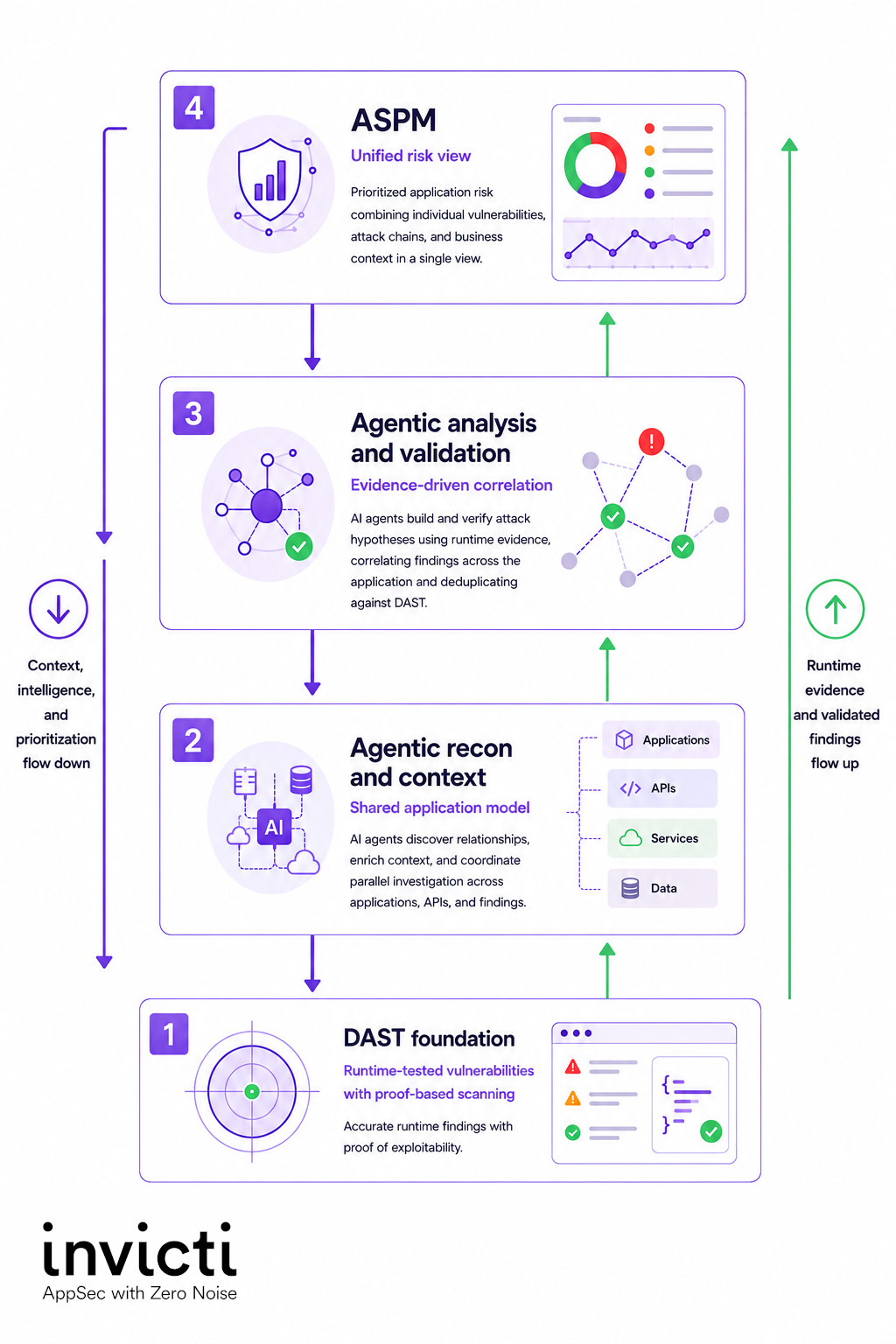
Effective attack chain intelligence depends on architectural decisions about shared state, coordinated planning, and runtime validation – capabilities that need to be designed into the system rather than added as an isolated AI assistant on top of an existing tool. And coordination alone isn’t sufficient. The agents still need something to anchor their conclusions against – and that anchor should be runtime evidence rather than inference. An agent that reasons its way to a finding without checking it against actual application behavior is merely producing a hypothesis, however sophisticated the reasoning. A reliable architecture should pair intelligent coordination with a proven runtime engine that can confirm or reject what the agents surface.
The agents plan and coordinate. The runtime testing engine confirms. That division of responsibility is what makes findings trustworthy rather than merely plausible – and it’s what separates architectures built for attack chain intelligence from thin AI wrappers around conventional scanners.
The validation layer: where signal separates from noise
More findings aren’t progress if they require the same manual triage at the other end. Any serious approach to attack chain intelligence has to include confirmation – runtime proof that a suspected vulnerability chain is actually exploitable, not just theoretically possible. This is where the distinction between DAST validation and agentic validation matters:
- DAST confirms individual vulnerabilities against known classes
- Agentic validation takes those confirmed findings and tests whether multi-step combinations hold up under real application conditions
The two aren’t competing – they’re sequential.
This is where Invicti’s 20-plus years of runtime testing expertise becomes load-bearing in how Invicti’s agentic penetration testing capability is built. The same proof-based scanning techniques that underpin Invicti’s DAST engine are applied to validate what the agents surface. Candidate findings are checked for exploitability before they appear in a report. Where an agentic finding overlaps with something conventional DAST already identified, it’s deduplicated and enriched rather than replicated – so teams get the benefit of both engines without the noise of redundant reporting.
Runtime validation changes the economics of security operations. Instead of asking engineers to determine whether an AI-generated attack path is real, the platform performs that verification during the assessment. Engineers spend time fixing confirmed issues rather than interrogating speculative ones – and security leaders can trust that what’s in the report reflects actual application risk, not the AI’s best inference about it.
For practitioners doing technical triage, the AI coordinator exposes its reasoning – what it tested, why, and what evidence it found – so there’s no black box to take on faith. For security managers and CISOs, the practical consequence is that the report represents confirmed, reproducible risk rather than a backlog of maybes.
Context ingestion: starting with the right preparation
Experienced penetration testers rarely begin with no context. They review architecture diagrams, prior reports, source code, and API documentation before planning an engagement – because that preparation shapes where they look and what attack paths they consider worth pursuing. Agentic testing benefits from the same preparation.
Rather than approaching every target cold, Invicti’s agentic pentesting supports uploading source code and supporting documentation – prior penetration testing reports, architecture diagrams, API specifications – as part of assessment setup. An agent that already understands the application’s technology stack, its authentication model, and the areas a previous engagement flagged as interesting can generate a more targeted attack plan than one inferring all of that from scratch. The resulting assessment is more focused and more likely to surface the high-value issues that broader automated scanning is less equipped to find.
For enterprise teams running assessments across large application portfolios, this also means that institutional knowledge about an application – the kind a skilled human pentester accumulates over time – can be preserved and reused rather than lost between engagements.
How agentic testing fits into a broader AppSec program
An agentic pentesting tool doesn’t replace DAST any more than a human pentester replaces automated scanning because each has a different role to perform.
Automated testing provides consistent, scalable coverage across large application portfolios. Agentic testing applies adaptive exploration where relationships between findings matter most: on complex workflows, authenticated flows with multiple user roles, APIs with intricate authorization models, and applications where a meaningful breach would require chaining multiple weaknesses together.
Understanding the strengths of each approach matters when deciding on deployment. DAST at scale remains the right tool for repeatable, broad coverage. Agentic testing earns its place at the layer above: exploring what the scan confirmed, reasoning about how findings interact, and validating whether the combination represents a path an attacker could actually follow.
Findings from agentic pentests feed into the Invicti Application Security Platform alongside DAST results and also external pentest reports if present, giving security teams unified visibility and prioritization. Rather than managing separate outputs from separate tools and engagements, teams work from a single view of application risk – with agentic findings tagged, enriched, and correlated against the broader signal the platform already holds. Together, they provide broader coverage, deeper investigation, and greater confidence that reported attack paths reflect what an attacker could actually achieve.
What to look for when evaluating agentic security testing tools
The term “agentic” is proliferating faster than the underlying capabilities. Buyers evaluating tools in this space should look beyond the label and ask specific architectural and operational questions.
The single most important question is whether the system confirms exploitability at runtime – not through reasoning, but through observable evidence from the application itself. This is the mechanism that replaces inference with proof, and it’s the clearest line separating an agentic tool built on mature security testing foundations from one that relies on its AI model being right. A system that can’t answer this question clearly is asking you to take its reasoning on faith. A system that can is showing you the evidence.
Runtime exploitability confirmation isn’t a quality-of-life feature. It’s the difference between findings your engineers can act on immediately and reports that always need manual validation before anyone trusts them enough to remediate.
Additional questions worth asking vendors:
- Do agents share context during an assessment, or run independently and aggregate results at the end?
- How does the tool handle authenticated testing across multiple user roles?
- Can the tool ingest application-specific context – source code, documentation, prior findings – or does it treat every target the same?
- Can a developer act on the output without a security professional validating and translating it first?
The answers you get separate tools with genuine architectural investment from scanners that have adopted agentic marketing language without changing how they fundamentally operate.
Conclusion: Demand validated attack chains, not merely plausible ones
Agentic penetration testing is most valuable when it’s understood as an extension of proven security testing, not an alternative to it. DAST finds and validates individual vulnerabilities accurately and at scale. Agentic testing explores how those validated vulnerabilities combine, confirms whether the combinations are exploitable under real application conditions, and surfaces the attack chains that matter most – routed through the same platform where the rest of your AppSec program lives.
The question to ask of any security tool in the agentic space isn’t what AI model it uses but whether that AI produces validated attack chains or merely plausible ones – and whether your team can immediately act on the findings. That distinction is what separates a genuine advance in application security from a more sophisticated way of adding noise.
Want to see how coordinated agent testing works in practice? Explore Invicti’s agentic penetration testing capability or request early access.
Frequently asked questions
Frequently asked questions about attack chain intelligence
Attack chain intelligence is the ability to identify how multiple vulnerabilities in an application can be combined into a real-world attack path. While security testing surfaces individual weaknesses, attack chain intelligence maps the relationships between them to say which sequences are exploitable and which combinations represent material risk rather than theoretical exposure.
Individual findings can be accurate within their scope, but they typically don’t reveal how separate vulnerabilities interact. A confirmed injection point and a confirmed authorization weakness are each a valid finding – but whether they can be chained into an attack path requires a layer of analysis that looks across findings rather than at each one in isolation. That’s what coordinated agentic testing adds on top of conventional scanning.
Multiple specialized agents collaborate throughout an assessment, each focused on a specific role or vulnerability category but sharing context with the others. A reconnaissance agent builds a shared model of the application – its structure, authentication flows, user roles, and API surface. Testing agents work in parallel against that model, with visibility into what the others are finding. When one agent surfaces a weakness, others can investigate whether it connects to something they’ve found. For tools that provide runtime verification, a validation layer then confirms runtime exploitability before findings reach the report.
DAST provides broad, repeatable runtime coverage across large application portfolios – it’s the right tool for consistent, scalable detection, and Invicti DAST also confirms findings with runtime proof. Agentic penetration testing extends that foundation with adaptive planning, coordinated agent behavior, and multi-step reasoning aimed at understanding how vulnerabilities combine. The two are complementary: DAST provides scale and accuracy, agentic testing provides depth where context-dependent, chained risks matter most.
Claiming the “agentic” label is easy, so ask vendors specific questions about the agentic architecture:
- Do agents share context during an assessment or just aggregate results at the end?
- Is exploitability confirmed at runtime before findings are reported, or are results based on inference?
- Can the system ingest application-specific context like source code or prior pentest reports?
- Does the output show the reasoning behind findings, or just the findings themselves?
Genuine multi-agent architecture built on proven runtime testing produces demonstrably different answers to these questions than AI layered onto a conventional scanner.
Without runtime validation, an agentic system produces its best inference about exploitability – which may be sophisticated and convincing, but isn’t the same thing as proof. Runtime validation is what converts a plausible attack chain into a confirmed one by testing each hypothesis against actual application behavior before it surfaces in a report. The practical difference is that confirmed findings go straight to remediation, while unverified ones need another round of manual investigation before anyone trusts them enough to act.
Experience the future of AppSec
